2004
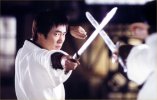
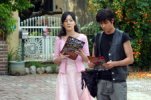

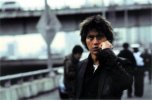
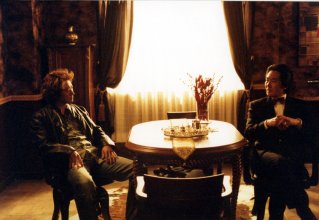
From left: "Arahan", "3-Iron", "Taegukgi", "Some"
As 2004 opened, the Korean film industry was still buzzing with the surprising success of films like Oldboy, Untold Scandal and Memories of Murder from the previous year. In contrast to 2001 and 2002, when inexpensive high concept comedies ruled the box-office, audiences in 2003 showed a clear preference for work by experienced filmmakers with a distinctive directorial style. The biggest films of 2003 also featured well-known actors and showed considerable attention to production values. "Well-made" became the new buzzword of the industry, as producers noted that audiences were demanding more quality of local films.
The year 2004 opened with a new twist to this trend: the "well-made blockbuster." Many of Korea's recent attempts at making big-budget genre movies were hampered by directorial inexperience, weak storytelling, or a lack of A-list stars, but Silmido (released in the last week of 2003) and Taegukgi gave Korean audiences a new taste of slick, homegrown, star-filled event movies. Apart from appealing to younger audiences with their stars and special effects, they also attracted older viewers in droves with their subject matter related to the Korean War and modern Korean history. The results at the box-office were stunning: both films passed the previously only dreamed-about 10 million admissions barrier.
However the success of the two films also brought new anxieties about the direction in which the Korean film industry is headed. The tremendous distribution and marketing clout wielded by Showbox and Cinema Service in releasing their movies had the side effect of pushing many smaller movies off the screens. The idea that money and power are unevenly distributed in the local film industry has come to receive more and more attention from critics and the press.
At the same time, international film festivals have provided a respite for observers worried about the increasing commercialism of Korean cinema. In February, maverick director Kim Ki-duk's tenth film Samaritan Girl won the Best Director prize at the Berlin International Film Festival. In May came even bigger news, when Park Chan-wook's Oldboy from 2003 screened in the competition section at the Cannes International Film Festival and walked off with the Grand Prix (missing the festival's top prize the Palme d'Or by one vote on the jury, according to some reports). Finally in September, Kim Ki-duk returned with yet another film 3-Iron, shot and edited in under two months, that carried home the Best Director award at the Venice International Film Festival.
Despite these accolades, however, the general feeling among many critics is that this is a bit of a down year. Few films have exceeded the expectations that came before them, and general audiences as well seem to be less enthusiastic about the local films on offer. It may take until next year, when many of Korea's best known directors return with new films, that the excitement returns. (written on Nov. 13)
Reviewed below: Once Upon a Time in High School (Jan 16) -- Ice Rain (Jan 16) -- Spy Girl (Jan 30) -- Taegukgi (Feb 5) -- A Smile (Feb 13) -- Mokpo, Gangster's Paradise (Feb 20) -- Desire (Feb 20) -- Samaritan Girl (Mar 5) -- Mr. Handy (Mar 12) -- Sweet Sixties (Mar 19) -- When I Turned Nine (Mar 26) -- The Wolf Returns (Apr 2) -- Dance With the Wind (Apr 9) -- The Big Swindle (Apr 15) -- Arahan (Apr 30) -- Woman is the Future of Man (May 5) -- Low Life (May 21) -- Clementine (May 21) -- Windstruck (Jun 3) -- Face (Jun 11) -- Someone Special (Jun 25) -- My Mother, the Mermaid (Jun 30) -- Everybody Has Secrets (Jul 30) -- The Doll Master (Jul 30) -- Bunshinsaba (Aug 5) -- Hypnotized (Aug 6) -- Fighter in the Wind (Aug 12) -- To Catch a Virgin Ghost (Aug 13) -- R-Point (Aug 20) -- A Family (Sep 3) -- Spider Forest (Sep 3) -- Ghost House (Sep 17) -- Mr. Gam's Victory (Sep 17) -- Springtime (Sep 24) -- 3-Iron (Oct 15) -- Some (Oct 22) -- A Moment to Remember (Nov 5) -- DMZ (Nov 26) -- Flying Boys (Dec 3) -- My Generation (Dec 3).
| Korean Films | Nationwide | Seoul | Release Date | Weeks | |
|---|---|---|---|---|---|
| 1 | Taegukgi | 11,746,135 | 3,509,563 | Feb 5 | 13 |
| 2 | My Little Bride | 3,149,500 | 876,600 | Apr 2 | 8 |
| 3 | Once Upon a Time in High School | 3,115,767 | 1,023,601 | Jan 16 | 6 |
| 4 | Ghost House | 2,890,000 | 751,340 | Sep 17 | 6 |
| 5 | A Moment to Remember | 2,565,078 | 797,593 | Nov 5 | 4 |
| 6 | My Brother | 2,479,585 | 699,725 | Oct 8 | 5 |
| 7 | Fighter in the Wind | 2,346,446 | 634,897 | Aug 12 | 5 |
| 8 | Windstruck | 2,199,359 | 659,380 | Jun 3 | 4 |
| 9 | Romance of Their Own | 2,189,453 | 574,511 | Jul 23 | 4 |
| 10 | The Big Swindle | 2,129,358 | 776,898 | Apr 15 | 7 |
| All Films | Nationwide | Seoul | Release Date | Weeks | |
|---|---|---|---|---|---|
| 1 | Taegukgi (Korea) | 11,746,135 | 3,509,563 | Feb 5 | 13 |
| 2 | Troy (US) | 3,851,000 | 1,513,408 | May 21 | 8 |
| 3 | Shrek 2 (US) | 3,300,533 | 1,285,594 | Jun 18 | 5 |
| 4 | My Little Bride (Korea) | 3,149,500 | 876,600 | Apr 2 | 8 |
| 5 | Once Upon a Time in High School (Korea) | 3,115,767 | 1,023,601 | Jan 16 | 6 |
| 6 | Howl's Moving Castle (Japan) | 3,014,800 | 979,800 | Dec 24* | 8 |
| 7 | The Day After Tomorrow (US) | 3,006,400 | 959,010 | Jun 3 | 6 |
| 8 | Ghost House (Korea) | 2,890,000 | 751,340 | Sep 17 | 6 |
| 9 | A Moment to Remember (Korea) | 2,565,078 | 797,593 | Nov 5 | 4 |
| 10 | Harry Potter and the Prisoner... (US) | 2,532,000 | 892,900 | Jul 16 | 5 |
* Includes tickets sold in 2005. Source: Korean Film Council (KOFIC).
Seoul population: 10.32 million
Nationwide population: 48.6 million
Market share: Korean 59.3%, Imports 40.7% (nationwide)
Films released: Korean 74, Imported 194
Total admissions: 135.2 million (=$738 million)
Number of screens: 1,567 (end of 2004)
Exchange rate (2004): 1151 won/US dollar
Average ticket price: 6287 won (=US$5.46)
Exports to other countries: US$58,284,600 (Japan: 69%)
Average budget: 4.2bn won including 1.4bn p&a spend
Top Ten Lists for 2004
Complete List of 2004 Releases with Seoul Box-Office
Short Reviews
These are some reviews of the features released in 2004 that have generated the most discussion and interest among film critics and/or the general public. They are listed in the order of their release.
 Once Upon a Time in High School: Spirit of Jeet Kune Do
Non-Koreans who watch a lot of Korean cinema are likely to have been surprised at one time or another at the depictions of violence in Korean schools. From Beat and Whispering Corridors to Friend and Bungee Jumping of Their Own, we have seen teachers beating students (sometimes with sticks or bats), students beating other students, parents bursting into classrooms and beating teachers... just about every combination imaginable. "Surely," such viewers must have asked, "Korean schools aren't really like that, are they?"
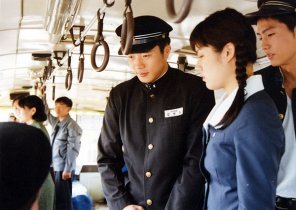 Director Yu Ha asserts in interviews that it is indeed this bad, if not worse -- at least it was in the 1970s, when he attended high school. Once Upon a Time in High School takes us back to these days when Korean society had reached the height of its authoritarianism and the country was rapidly modernizing. Young boys at the time were obsessed by the image of Bruce Lee (hence the film's English title), and Yu depicts in this movie both how difficult life was for high school boys in those days, and how Bruce Lee served as a model and inspiration years after his death.
The film focuses on three main characters: the soft-spoken Hyun-soo, played by rising star Kwon Sang-woo (My Tutor Friend); an intimidating fighter Woo-sik, played by Lee Jung-jin (Bet on My Disco); and Eun-ju from a neighboring girls' high school, played by debut actress Han Ga-in. When Hyun-soo transfers in as a new student he becomes friends with Woo-sik, and later the two of them meet Eun-ju on the bus. Initially the fights and troubles around them cause the three to become quite close, but as time goes by, divisions flare up and they begin facing their battles alone.
In some ways though, violence itself takes the lead role in this film. The teachers themselves barely make a show of keeping control, while wayward students with nicknames like "Stabber" or "Hamburger" fight with whatever sharp or blunt objects happen to be at hand. Hyun-soo, modeled in some ways after the director's own experiences, has trouble adjusting at first, but eventually the stress of his environment begins to take its toll.
Korean film critics, perhaps thinking back to their own experiences at high school, gave the film a warm welcome at its first press screening. Audience members also responded with strong initial interest, although viewers seemed divided after actually seeing the film (for the record, my wife hated it and my brother-in-law thought it was fantastic).
As an outsider who went to a high school where students got into fights, but generally stopped short of stabbing each other with pens, I found myself with mixed feelings about this movie. It's not that I have trouble believing that this sort of thing could happen -- I'm sure it could. But I do have some trouble with the way the film seems to view the violence with equal parts awe and admiration, particularly towards the end. I also found it somewhat conventional, and I'd hoped for a little more from the director of Marriage is a Crazy Thing. Many of the film's details are quite evocative or impressive, but in the end it doesn't seem to be saying too much more than, "Man, we had it bad..." (Darcy Paquet)
(Trailer: 300k)

A man, a woman, a man, a mountain. This basically describes Kim Eun-sook's first feature film, Ice Rain. Kim's short film "The Execution" had competed at Cannes in 1999, but the short form isn't usually a platform to immediate blockbuster proportions. Yet, somehow Kim was able to procure the backing to debut as director and writer with this mountain-climbing extravaganza, making her the first Korean woman to take the helm of such a venture.
The film flashes back from a mountaineering expedition in Alaska to memories of two of the mountaineers, Joong-hyun (Lee Sung-jae - Public Enemy, Dance With the Wind) and Woo-sung (Song Seung-hun - Calla) These memories are of married Woo-sung's affair with Kyung-min (Kim Ha-neul - Ditto, My Tutor Friend), an affair young, single Joong-hun wishes he had had. In the beginning, the development of the relationship each man had with Kyung-min receives equal representation along with the spectacular vistas of the treacherous hike up the snowy mountain. The visual enjoyment in the first half of this film is well executed by cinematographer Yoon Hong-sik (Tube, The Way Home) and for the most part the realism of the special effects affect as intended. The second half of the film emphasizes the relationship over the spectacle, thanks to a stalling of Joong-hyun and Woo-sung's climb up the mountain.
 Where Ice Rain works for me is in its refusal to fall fully into the mountain as cliched metaphor for 'problem to surmount' or 'goal to reach.' There is no "change" caused by the mountain per se, just reflection on actions past. Instead, Kim has utilized the mountain to conjure up an interesting exploration of why it is we take risks, why it is we put ourselves in danger: the physical danger of mountain-climbing against the emotional danger of falling in love/lust or into relationships doomed to fail. Two scenes vividly underscore this, Woo-sung reaching into hot coals to retrieve Kyung-min's gift of her "love tooth," and the film's most powerful moment for me, Kyung-min's throat-clench reaction to her mother's surprise intrusion of her affair. As in a relationship, more than one person risks getting hurt since climbing partners are connected through rope. One slip on your part and your partner can fall with you. In this way, Ice Rain had me recalling the three attached partners in Takeshi "Beat" Kitano's Dolls without the absurd (in a positive way) elements of that film.
Where Ice Rain doesn't work for me is in the weak initial development of the relationship between Joong-hyun and Kyung-min. Perhaps the problem really lies in the English translation, but the initiation ritual of the relationship suffers from a too-cutesy-ness to which melodramas are vulnerable to fall prey. However, such does allow for the intended differentiation between Joong-hyun's immaturity and the more adult relationship Woo-sung is capable of with Kyung-min. The irony is that Woo-sung's illicit affair with Kyung-min comes off more legitimate than if she'd established a relationship with unattached Joong-hyun. Another problem with the film is the need to reflect too soon on matters that happened earlier in the film, such as Kyung-min's recalling of the "love tooth" incident.
It appears that the film did not work for Korean audiences because it performed poorly at the box office. Of the 50 Korean films released by the end of August, Ice Rain was roughly in the bottom 30% of both (Seoul) admissions and Per (Seoul) Screen Average (PSA). Tossing out the films that were shown in under 10 theaters and the huge anomaly of 2004, Taeguki, Ice Rain still only managed 45% of the year's average PSA. A positive sign is that it didn't fail as greatly as 2003's blockbuster bomb, Natural City, acquiring 132% of Natural City's PSA. And when looking at the other films so far this year that were placed on 20-30 screens, Ice Rain met 79% of the average admissions and 86% of the average PSA.
Normally, I could care less about the financial take of a film since my primary interest is that of aesthetic and sociological/political study. But a blockbuster implies commercialism, so here I'm judging the film on its own intent, which is to make money. And with only around 80,000 (Seoul) admissions, this film didn't live up to its own hype. I'm not aware of how much this film needed to gross to end up in the black, but guesstimating about the on site needs required when filming on a mountainside, I'd bet the financiers were not happy with the results.
Some may question whether Ice Rain should qualify as a "blockbuster." In Movie Blockbusters edited by Julian Stringer, Stringer notes what makes a "blockbuster" a blockbuster has not received much academic study. What he found most often denotes a blockbuster is self-reflexivity, ('I AM a blockbuster, damn it!'), and two factors of size, budget and spectacle. (The size of the eventual box office take is after the fact and qualifies the already established blockbuster as a success or failure.) Since Ice Rain announces itself as a blockbuster and I assume the budget was considerable, it meets those two factors. Although I find the expansive views of mountain climbs large enough of a spectacle to warrant the blockbuster label, the film's eventual greater emphasis on the relationships in the pedestrian settings of the city could lead some to question its blockbuster luster.
Regardless of its blockbuster legitimacy, considering that Kim Ha-neul was coming off of the sassy-fied success of My Tutor Friend the year before and that one of the most popular outdoor activities in South Korea is hiking the mountains of regions such as Kangwon-do, we must concede that Ice Rain performed below expectations at the box office. Even greater disappointment arises when we recall that another mountaineering film was extremely popular in South Korea, a fact that many a Korean cineaste wishes would simply disappear into thin air. That film? Sylvester Stallone's Cliffhanger. (Adam Hartzell)

Part of me wants to call Spy Girl, Park Han-joon's advertisement for a major fast food chain... What's that you say? 'Don't you mean Park Han-joon's film, Adam?' Well, no, I don't. I'm absolutely serious when I say this film is first and foremost an ad for the I-refuse-to-mention fast food chain. Twenty-five percent of the film's running time is taken up by the fast food chain and I'm not just pulling that number out of my ass as what the ad space seemed like. I actually timed it. And I rounded down! With that amount of cinematic space as ad space, we must call this film what it was intended to be, an advertisement.
 And I'm sure this provider of unhealthy fare is happy w/ director Park's efforts, because the commercial space is clearly and positively associated with desire. We have several Lolita-ly dressed hotties, or as the film-cum-ad labels them, "Angels", who work for the imposed-upon-the-viewer fast food chain. This commercial site is presented as the assumed site of everyday consumption for all the characters. The entire male population of the high school across the street from this cinematic billboard is portrayed as a horde unable to refrain from bumrushing the chain in order to order from the angel-est of Angels, our gorgeous main character, "Hyo-jin" (Kim Jung-hwa). The boys' teacher even mentions his patronage of the chain to further solidify its everyday presence within all of South Korean society, the young and the old.
Anyway, as I was saying, part of me wanted to call this ad "My Sassy Spy Is a Gangster III", but not all those references really stick when fully examined. At one point the subtitles do have a character label our secret agent as "sassy" and there are a few dashes of wire-fu dropkicks, but those references are just as minimal in the larger scope of the ad as the loving foot fetish scene straight out of Spring Bears Love. No, the only substantial reference point here is Jang Jin's The Spy. Yet, I won't call this a copycat since Jang doesn't own a copyright on all films about a spy. Spy Girl's re-gender-ized version tells its story through well situated flashbacks that could have easily become confusing in lesser hands. Director Park and Screenwriter Ha Won-jun provide us with a nicely layered back story regarding how "Hyo-jin" and Go-bong (Gong Yu) met each other. Let me first explain why I keep putting our North Korean spy's name between quotes. See, she's taken on the identity of the biological daughter of her sort of adoptive parents, the father of which is a North Korean contact. So her name is not really "Hyo-jin", but for most of the film, that is how she's known. While waiting for her designated hit to emerge, she takes a job at the afore(not)mentioned main character of this commercial. Unbeknownst to her, she is also being stalked by boys at the neighboring high school who have put her up on their personal website without her permission, thus violating her, as their premier Angel. This Angel that is (and isn't) "Hyo-jin" is purported to be so famous that "those who don't know her are North Korean spies", leading "Hyo-jin" to believe her secret operation has been discovered.
That subtitle quote above is what provides much of the fodder for comedy, that is, playing off the ignorance a North Korean would convey from being severed off from much of the modern outside world, especially the world right next door, South Korea. Thus, some of the humor may be missed on the Western viewer, such as when "Hyo-jin" is asked to sing a popular South Korean song by her bullying co-workers. The most successful humor is that around "Hyo-jin"'s spy parents, who, although still feeling obligated to help her, are presented to have taken quite well to 'soul-less' capitalism, being quite the consumers, even legally traffic-ing in the most processed and unnatural of confections, symbolizing their complete assimilation into the simulations of capitalism. Yet, demonstrating the recent trend in South Korean cinema, the North Koreans are not the butt of all the jokes. Although in no way are these realistic portrayals of North Koreans, "Hyo-jin" is portrayed quite sympathetically without requiring her to convert to South Korean nationalism. In fact, her character is portrayed more than sympathetically. She is presented as someone we all, male and female, should desire. Her character even diverges from -- to coin a word off of Kyung Hyun Kim's use of "Remasculinization" to describe recent Korean male portrayals -- the "Refeminization" contained within a subset of South Korean cinema that requires all sassy-fied females to hide some psychoanalyzed trauma behind their feisty facades, even though, being from North Korea, "Hyo-jin" could have been easily characterized as harboring multiple traumatic experiences considering that country's present horrific problems.
Although humorous moments arise in Spy Girl, for the most part, the attempts at humor are too often ridiculous and haphazard rather than poignant and smooth as is the case with its predecessor The Spy. Nowhere close to being a high quality example of Korean comedies, Spy Girl still succeeds in its primary goal, to sell burgers. Hey, at least you can order those burgers with kimchi on them, right? (Adam Hartzell)

Being the director of a watershed hit like Shiri (1999) can give you some strong advantages when making your next film. It gives you the ability to attract top-name actors and crew. It becomes much easier to raise large sums of money from investors. Park Chan-wook (JSA) and Kwak Kyung-taek (Friend) chose to shoot smaller, more personal works after their record-breaking hits, but Kang Je-gyu took full advantage of his position and aimed for the stars. Taegukgi, which premiered close to five years after Shiri, ranks as the most expensive Korean film ever at $12.8 million and features perhaps the two hottest male stars in Korea. (Won Bin, when asked why he agreed to star in the film, is reported to have said, "You'd have to be an idiot to turn it down, wouldn't you?")
 Its title named after the South Korean flag, Taegukgi tells the story of two brothers from Seoul who are forcibly conscripted into the army shortly after the outbreak of the Korean War in June 1950. The older brother, played by Jang Dong-gun, decides that he must try to win a Medal of Honor in order to secure the discharge of his bookish younger brother, played by Won Bin. As the war progresses from the outskirts of Busan to the northern reaches of the peninsula, however, Jang's character grows distant and starts losing himself in the passions of war.
Certainly this film is unique in Korean film history for its large scale, its battle sequences and the intricate reconstruction of war-torn Seoul and Pyongyang. The crew deserves praise for the tremendous amount of effort they put into the look and feel of the movie. I found it particularly interesting to see a reconstruction of the street Jongno in pre-war Seoul.
The scenes of war shown here are quite impressive, but ironically they also contain one of the film's biggest disappointments. Presumably to give the audience a feeling of excitement, the director shakes his camera violently back and forth in all of the fight scenes. The result is that we can barely see the elaborate explosions and effects, robbing the film of its greatest asset. Viewers who go to see this in the theater are strongly advised not to sit in the front rows, in order to avoid getting nausea from the lurching camera (not to mention the very gory scenes of battle carnage).
In general, one gets the sense that this film could have been crafted into a far more moving and eye-opening account of the most destructive event in Korea's history. For much of Taegukgi's extensive running time we are focused on the melodramatic discord that springs from the older brother's decision to sacrifice himself. This personal story dominates the film to the extent that, in some ways, the war is merely an elaborate backdrop. The film also makes little effort to say anything new about the conflict. North Korean soldiers are portrayed as crazed fanatics (no JSA-style humanism here), while the Chinese are just a teeming horde. It does try to show the ruthlessness of Southern as well as Northern forces (which provides for some well-acted cameos by Kim Soo-ro and Kim Hae-gon), but this is hardly new. Ten years ago, Im Kwon-taek's Taebaek Mountains portrayed the damage wrought by violent anti-communism with far more conviction.
In the end analysis, Taegukgi is a commercial blockbuster with little to say, but a keen sense of how to attract local viewers with spectacle and melodrama. As I write this, it is playing on a record 450 screens across Korea and it has become the first film ever to sell 2 million tickets in five days. With a long box-office run virtually guaranteed, it appears that Kang Je-gyu will continue to be able to call the shots for his future productions. (Darcy Paquet)
(Trailer: 300k)

A Smile opens with a close-up of a woman's eye subject to an ocular test. It belongs to So-jeong (Choo Sang-mi, The Contact, Turning Gate), a photographer. It is revealed that she is afflicted with retinitis pigmentosa, a rare disease that kills optic nerves from the periphery, eventually leading to blindness. Her graduate student boyfriend Ji-seok (Song Il-gon) is supportive, but she abruptly terminates the relationship with him. She returns to her family for a funeral service, and briefly dabbles in a project photographing the famous statue of the Maitreyan Boddhisatva and explores the ancient tombs of Kyungju. In the end, she abandons photography and decides to take lessons for flying mini-planes from a loner ex-Air Force soldier (Jo Seong-ha).
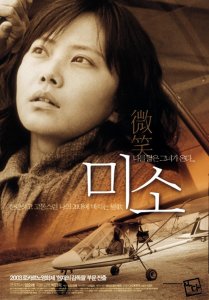 A Smile, a directorial debut film by newcomer Pak Kyung-hee, is a stoic, aloof and somewhat doleful character study. Pak employs a haiku-like, spare style and medium-distance compositions (reminiscent of Yim Sun-rye, who served as the producer) to delineate the subtle psychological changes of a young woman faced with a personal catastrophe. Perhaps courageously for a Korean film, it presents a protagonist who refuses not only to display emotion but also to explain herself. De-glamorized and wrapped up in functional, baggy clothes, Choo Sang-mi delivers a restrained, finely tuned performance in the role of So-jeong. She is particularly effective in the country home sequence, which I thought was the best part of the film, stoically withstanding both abuse and indifference from her family members, including her weasel-like older brother (Pak Won-sang from Waikiki Brothers), disgustingly immersed in patriarchal-misogynistic values but nonetheless portrayed as real people.
A Smile is the kind of motion picture that probably reads better as a screenplay than as an actual film. Visually, it is rather claustrophobic, even when opened up for location shooting, and its devices for illustrating So-jeong's changing psychology are more interesting as ideas than as concrete cinematic expressions. For instance, So-jeong's spiritual engagement with the Maitreyan Boddhisatva (the film's title appears to be based on the famous "smile" worn by the statue) is obscurely presented. I was also disappointed by the fact that the flight sequences were shown in such a prosaic manner. Watching the film, I never got to understand what So-jeong wanted so desperately to see from the sky, even at the cost of breaking up from her kindly boyfriend.
The final image recalls that of Kurosawa Akira's Ran and opens the film up for an allegorical interpretation about the general human condition. It smacks of didacticism and high-handedness, but at the same time remains a striking and affecting sight, a fitting resolution to this obstinate yet plucky debut film. (Kyu Hyun Kim)

This overcooked ratatouille is a curious throwback to the yesteryear's trend: gangster comedy. It covers all the bases of the vilified subgenre: the glamorous stars cast as hapless idiots or foul-mouthed miscreants, the Cuisinart mixture of usually irreconcilable genre conventions and the stylized "action" scenes and macho CF moments. What distinguishes the film for me from its clones is the homoeroticism subtext so insanely in-your-face that it threatens to become the movie's central theme.
I have read elsewhere that Mokpo was originally conceived as a non-comedy project, and its rather ambitious, convoluted subplots indeed suggest a Korean rehash of Infernal Affairs. The film stars Jo Jae-hyeon (Address Unknown, Bad Guy) as a smart but nerdy cop, Lee Soo-cheol. Despised by his fellow cops, Soo-cheol volunteers for a dangerous mission infiltrating a Jeolla Province-based crime syndicate headed by a young boss, Seong-gi (Cha In-pyo, Season in the Sun, Iron Palm). Determined to expose the syndicate's drug smuggling operation, Soo-cheol gains Seong-gi's trust, but in the process begins to find his loyalties torn between the police and the criminals.
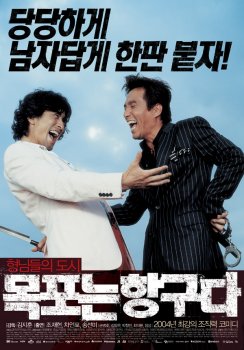 Judged purely in terms of the jopok comedy genre, Mokpo is a middling achievement, more colorful than the usual drek, but not as well-crafted as, say, My Wife is a Gangster. Jo Jae-hyeon's ability to give a real performance, while surrounded by the comic sketches straight out of the dumbest episodes of Gilligan's Island, is nothing short of impressive. As for Cha In-pyo, I frankly have never understood why he is so popular and this film certainly does not suggest any new clue. The casting of Jo as a "little brother" underling of Cha is such a bizarre setup, a little like casting Nick Nolte as a teenage brother of Andy Garcia, that any chance of taking Cha's character seriously evaporates. Of course, the character itself would have defeated the efforts of any good actor. To cite but one example, director and writer Kim Jee-hoon attempts to render Seong-gi cutesy-poo by making him a gigantic fan of My Sassy Girl who has memorized all of its lines. He should have cast Cha Tae-hyeon in Seong-gi's role. Cha Tae-hyeon as a crime boss, now that's creative casting. The charismatic presence of Son Byeong-ho (Oasis, Failan) as the #2 gangster makes me wistful about seeing Jo Jae-hyeon and Son squaring off as opponents in a serious crime film, the kind of film we will never see in today's Korean film industry, increasingly taken over by the concerns about the bottom line.
Some words on the film's curious homoeroticism are due. The film's plot involves retrieval of a maritime treasure in a sunken Chinese ship. In fact, the film's real coveted treasure is Seong-gi's penis ("seong-gi" is a synonym for "sexual organ" in Korean). The filmmakers laboriously hint at this throughout the movie, culminating in an oral sex joke between Jo and Cha. Although the setup is a truly lame parody of a famous scene from Oldboy, it encourages the viewers to laugh at Cha closing his eyes and softly moaning while Jo is, ah, rolling his tongue with loud slurping noises over a thingie jutting out between Cha's legs. What are we to make out of this? This and a few other scenes in Mokpo carry with them an air of sexual panic, as if the filmmakers are trying desperately to exploit the sexual attraction among the male characters, without honestly acknowledging it. Not surprisingly, the climactic orgy of slow-motion violence, in which gallons of bodily fluids are shed and shared, can be interpreted as the "safe" substitute for actual acts of lovemaking. At any rate, the "oral sex joke" was the only surprising thing for me in the whole movie. It almost gave me the hope of actually seeing a sex scene between Jo and Cha (maybe as a Freudian dream sequence?). Instead, of course, the film ends with the lobotomized image of a heterosexual nuclear family, denying with half-hysterical laughter what I now suspect... that this film is really made for Korean men who find Cha In-pyo sexually attractive, but must pretend that it's their girlfriends who want to see Cha on the big screen.
Of course, let's not forget that the movie comes fully equipped with the potful of pee-pee and ca-ca jokes. What would a Korean comedy be without them? Oh look! The dumb comic relief guy is having diarrhea and he forgot to lift the lid! Thatsa veddy fun-nee! Groan...
Finally, I freely confess that the heart-stoppingly unmirthful "comic dialogues" spouted by various supporting characters was one factor that made me seriously consider bolting out of the theater. I just had to clench my teeth and get over them. In one way, the non-Korean-speaking viewers who have to rely on English subtitles are spared of the worst element of these Korean "comedies." (Those who have sat through the movies like Cabin Boy and Ishtar would appreciate just how torturous unfunny lines in unfunny comedies can be) Count your blessings, kimosabe, 'tis a sign that Big Daddy in the Sky has not given up on you yet.
Mokpo, Gangster's Paradise is a grating jopok comedy almost surrealistic in its extremist, loony-tunes reworking of the once-safe formulae, perhaps revealing more clearly than its subdued predecessors the masculine anxieties that underlie much of what passes for entertainment in contemporary Korea. (Kyu Hyun Kim)

A rich housewife Rosa (Lee Su-ah), married to a psychiatrist Gyu-min (An Tae-geon, Oasis, Jungle Juice), discovers that he is two-timing her with a leather-clad pretty boy Leo (Lee Dong-gyu). Rosa approaches Leo, who moonlights as a boy toy for a gaggle of wealthy housewives, and "buys" his services with the money she raised among her friends. And yet, she continues to pretend as if nothing is amiss with her barren married life. When Gyu-min spurns Leo and half-heartedly attempts to reconcile with his wife, they are further ensnared in the cycle of mutual abuse and despair.
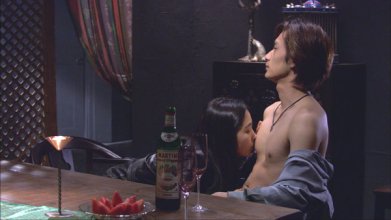 Desire is, in a nutshell, a long love letter to Michaelangelo Antonioni, especially his L'Avventura and Blow-up (the Korean import title of which was, you guessed it, Desire). For a regular Korean film, the discovery that the husband is having an affair with another man would be the big plot twist in the midpoint or even a climactic revelation. But in Desire, this issue is taken care of in the first five minutes. The rest of the film, virtually dialogueless, is devoted to the delineation of Rosa and Gyu-min's loveless marriage, and exasperating, sometimes repellent actions of Rosa and Leo to inject some meaning into their hollow lives. The narrative is bewilderingly elliptical: most characters are either frightfully annoying or depressingly banal.
Director Kim Eung-soo has made what may be termed as an anti-melodrama: imagine a dark, humorless version of My Sassy Girl in which Jeon Ji-hyeon's "The Girl" rapes Cha Tae-hyeon's Gyeon-woo with a dildo and he still tags along with her like a puppy on a leash. (To avoid a misunderstanding, let me state that Desire exploits Rosa's character in a familiar, leering European-art film fashion: don't expect any sexually progressive viewpoints here) However, Kim is so committed to blotting out any chance of the audience identification that might interfere with his fine-tuned presentation of the ennui and pointlessness of the upper-class Korean life, that he risks turning the whole film into an exercise in dehumanization, on the part of the audience as well as the characters. By the time the movie reaches its denouement, involving Rosa's tearful face and a bouquet of funeral flowers, many among the audience would be crawling up the walls, had they not already left the theater in utter confusion.
The film is certainly beautiful to look at. Director Kim has great eyes for composition, color and production design (Did he study painting?). And there are a few scenes that sneak in Bunuel-like wicked humor, such as the dinner party at Gyu-min's place. After the expensive, elegant dinner he, Rosa and the guests gather together and watch Happy End (1999) with the solemnity and absorption of attending a religious ceremony.
I think the film's biggest weakness is precisely the factor that the marketers would attempt to use to sell it (and fail miserably): sex. Sex scenes in this film are so frigid and un-erotic that they become almost (almost, but not quite) fascinating, as if they are reconstructions of human sexual conduct by a Silicon-based alien intelligence. If this is the effect that Kim Eung-soo had in mind, he succeeded. At least there is no confusion in this case about whether the title was meant to be ironic.
Coldly gorgeous, Desire is a technically superior production that earns respect for being so adamantly against the commercial conventions of Korean cinema, even at the risk of alienating the viewers. (Kyu Hyun Kim)
(Premiered at Locarno International Film Festival in 2002, but released commercially in February 2004)

In tag-lining his Silver Berlin Bear award-winning film Samaritan Girl with the biblical reference, "He who is without sin, throw the first stone," director Kim Ki-duk has allowed himself cover from critics. Such a tagline deflects any negative criticism before the critic has even criticized. It argues that only the critic who is without criticism themselves should throw damning words at Kim's film, otherwise, the critic should remain silent. And who among us is without "sin", hypocrites that we all are? Such underscores the marketing acumen, if not directorial skill, of Kim, a man who has quickly risen, justified or not, to become one of the most recognizable Korean directors throughout the world through his relentless work ethic that enables him to complete projects with a profitable - at least through overseas sales - efficiency that would make the members of many corporate board rooms around the world nod in approval.
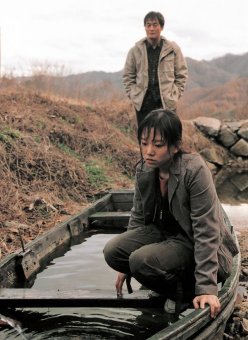 Although I have found most of Kim's work ineffectual, leaving his violent vision in the theater where it belongs, Samaritan Girl is an exception. Although it presents many of Kim's faults as a director, such as moments of poorly guided acting and awkward forcing of style, it also presents Kim's vision at its strongest since The Isle. Kim's films were mostly the downside of my devoting my writing to South Korean cinema. Samaritan Girl hasn't brought a brightside, but at least a side that provokes interesting thoughts beyond the theater.
The film is set up as a triptych. It begins following two schoolgirls, Jae-young (Seo Min-jeong - Jenny, Juno and again in Kim's The Bow) and Yeo-jin (Kwak Ji-min - Wishing Stairs, Red Eye). Jae-young prostitutes her body with older men in a belief that she is following in the practices of a fabled Buddhist prostitute from India who transported johns towards enlightenment through the nirvana between her legs. Yeo-jin is upset by Jae-young's prostituting herself, finding the men she sleeps with disgusting, but concedes to act as her lookout and, in a sense, her pimp, since she is the one who calls the johns and snatches Jae-young from them when Jae-young steps across the line from business relationship into something deeper, and by extension, more dangerous. Based on Jae-young's almost mythic characterization as a sprite in her look and behavior, a possible interpretation is that Jae-young and Yeo-jin are actually two halves of the same person. This is further supported by Jae-young's Corsican-like bodily response in the hospital when Yeo-jin supposedly loses her virginity with Yeo-jin's favorite client, a musician. And the second section of the film does indeed have Yeo-jin echoing in the tradition of fabled Buddhist prostitute with an ease as if she's done this before. However, Yeo-jin decides to sleep with and return the money to every john Jae-young had previously serviced. Little does she know, her devoted single father (Lee Eol - Waikiki Brothers, and again with Kwak in Red Eye) discovers Yeo-jin's after school activities and begins stalking his daughter's tricks.
But he doesn't confront her at all with violence beyond vengeance as we've come to expect from Kim's oeuvre, not even in the third section of the film. He merely seeks out the johns to confront them for their immoral liaisons with his under-age daughter. And it is this aspect of Kim's film that is so compelling. I sat during this entire film wondering when the misogyny would arise and was astounded to find none. Sure, you could argue that his portrayal of each schoolgirl prostitute is a male fantasy, but to do so you'd have to deny how the reality of illegal prostitution intrudes at precise moments when the audience might be getting too comfortable with that interpretation. The only other claim of misogyny is trumped by the fact that it is a dream sequence that demonstrates a character's masochistic tendency, a masochism that Kim's narrative will not allow.
Kim gives me enough of what I want from cinema, something to provoke thoughts upon layers of other thoughts, that I will secede and give him major props here. Although it'll take time to realize if those layers build a stable structure or a shaky foundation, I have recently found myself wandering many productive critical avenues. What might Kim be saying about masochism that I've been missing in all the sadism? And, are we supposed to see the father as a Jesus figure? He enters his daughter's room just after we notice a portrait of a blue-eyed interpretation of Jesus. He seeks stigmata-esque wounds by hovering his hand over the hot stove. And, well, he indeed does throw the first stone. But there are equally plausible moments when this father/christ figure demonstrates that he is not without sin, such as the moment where we gaze with him along the body of his sleeping daughter. One of the more compelling aspects of the film that conveys the possible sinfulness of daddy is the score. The musician client Jae-young wishes to see in the hospital is called upon by Yeo-jin while working on a space-age sounding composition. And it is a similar sounding non-diegetic score that follows the father during some of his stalking, alluding to the fact that this father might know more about the evil ways of men than simply from observing.
Whether or not all of this combines into a greater whole for me still remains to be seen. Of all the ink and pixels spent on Kim, someone on the discussion board said it best when they wrote how Kim is equally overrated and underrated. (I searched and searched and searched but could not find which member wrote this so I'm sorry I can't cite you.) I would add to this that your reception of Kim can also be affected by which film you came in on. And if you came in watching Samaritan Girl, I can understand why you might be intrigued by his work. And like Yeo-jin's father to his daughter, I won't judge you for that. (Adam Hartzell)

The thirtysomething dentist Hye-jin (Uhm Jeong-hwa, Singles, Marriage is a Crazy Thing) resigns from a Seoul general hospital after fighting with a senior doctor. Blackballed and unable to get a job in Seoul, she decides to open a modest dental clinic in the countryside. But adjusting to the sleepy pace of a small fishing town turns out to be more difficult than Hye-jin thought. To her initial annoyance, a loud-mouthed local jack-of-all-trades Chief Hong (Kim Joo-hyeok, Singles, YMCA Baseball Team) interjects himself into her life. Not only is he the so-called "chief" of the Neighborhood Association, he is also a licensed real estate agent, interior designer, carpenter, occasional 24-hour store clerk and mediator for civil disputes relied upon by the rather unreliable town police. In addition to all these practical skills, Chief Hong sings ballads, plays golf and go and knows a thing or two about fine wine and artificial intelligence. Oh, and did we mention the fact that he is also a martial arts expert?
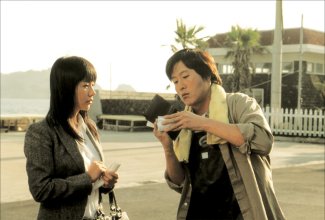 Mr. Handy is no Thanksgiving turkey, but it ain't chili con carne either, if you get my drift. I am not sure why the filmmakers thought they had to name this film If Something Happens to Somebody Somewhere, He Always Shows Up, Chief Hong in the original Korean, but I am fairly certain that its main target demographic is the young female moviegoers with disposable income. Director Kang Seok-beom and screenwriters Kang, Shin Jeong-gu and Yi Yoon-jin set Hye-jin up for every imaginable form of slights and harassments from men: being fondled in the rear end by a patient, being called a harpy, a hag or worse, and being thrown into a slammer for crashing into a male-chauvinist kid's automobile. The solution? It's Chief Hong to the rescue! When the slimy macho thugs need their asses whupped, Chief Hong is there to oblige! When Hye-jin runs into trouble with the police, Chief Hong bails her out! And of course, when Hye-jin wants to mope about her lonely, meaningless life, Chief Hong is there to wine and dine her and spout romantic poetry. He is like a comic book superhero who, instead of making the world safe for truth and justice, spends all his time getting rid of annoying people and problems for young Korean professional women. The idea is at least cute.
Disappointingly, Mr. Handy makes the serious mistake of compromising the powerful presence of Uhm Jeong-hwa, who radiates sex appeal like a Plutonium isotope and looks like she can eat all these macho thugs for breakfast. It is simply not believable that Hye-jin should fall for a dork, albeit a multitalented dork, like Chief Hong. Granted, he might be very useful to have around in the house. But then again, if your poodle could file income tax forms, drive you to the shopping mall, collect garbage bags and do the laundry, he would be darn convenient to have around, too. To put it simply, there are no sexual or even genuinely romantic tensions between these two characters: with no tensions, there is no real drama, and no real resolution, its teary climax eliciting a bored response from me, "Uhm (no pun intended), couldn't you just call him up on your cell phone?"
I wouldn't blame either Uhm or Kim for this low-octane outcome as they work quite well together (both starred in Singles, but their characters in that film had no chance to interact) and are obviously skilled actors. The problems with its basic premise and dramaturgy notwithstanding, Mr. Handy is competently put together, with nice cinematography and production design. I assume the tackily tasteless interiors of Hye-jin's big shot father's house (Ki Joo-bong, back in the saddle again) are intentionally so. On the other hand, the pace of the film seriously drags, especially in the middle section where Chief Hong's various "talents" are exposed with all the ingenuity of a junior-high school show-and-tell.
There is no point in second-guessing the filmmaker's designs, but if Chief Hong were a total fantasy figure that existed only in Hye-jin's imagination, that would have made the film more intriguing, or at least different, perhaps preventing the filmmakers from falling back on the Prince Charming complex, the cliche of all cliches in Korean romantic comedies. I wish that I could have liked Mr. Handy more than I do, and that it had the gumption to fully release the sexual energy of Uhm Jeong-hwa upon its viewers. As it stands, the movie is a well-intentioned, moderately pleasant comedy lacking in vim and vigor, not to mention genuine wit. (Kyu Hyun Kim)

Let's talk Marketing first. Concept-wise, director/writer Lee Su-in's Sweet Sixties was a great pitch. Let's take an underserved market, seniors, and let's gear a film specifically for them since movies, as opposed to cinema, are geared towards the young, presenting life as so few of us can actually experience it. Some of Korea's best older actors are cast in this film, such as Joo Hyun (Saving My Hubby, My Wife Is a Gangster 2) who plays Jong-dal and Song Jae-ho (Memories of Murder, Double Agent) who plays Pil-guk, each providing reference points to Korea's film industry in the 80s and 70s. Plus, as a thriving cinema that has finally been recognized internationally, titling the film "Sweet Sixties" alludes to the "Golden Age of Korean Cinema" of that decade. Such an allusion allows for the industry to broaden how Korean cinema is seen internationally and to younger Koreans. And Korean cinema history is further represented - and further back - by the wonderful, light green, faux-aged, old school-designed advertising poster that harkens back to the gorgeous posters of old so well documented in the book published by the Korean Film Archive, Traces of Korean Cinema from 1945-1959. In this way, Sweet Sixties is going back to the future in an effort to market its fascinating, long history while paying allegiance to its elders, both the elders from back in the day and the elders of today.
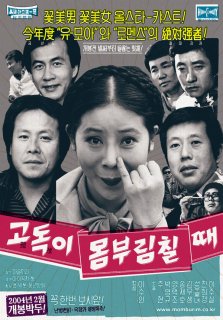 This is why I'm less enthusiastic with the alternative English title "Dances with Solitude" since all this synergy is lost and we are left with a wannabe title with its less than subtle reference to Hollywood cinema. Similarly disappointing, rather than score the film with something original and engaging as we've come to expect from recent Korean films such as Take Care of My Cat and A Good Lawyer's Wife, we have something that's so generic in its orchestral Hollywood violin swoops, that I'd expect to see us plopped into an American suburban cul-de-sac at the beginning of the film. Plus, there's a certain pandering to sentiments not even conveyed in the film with the poster selected as the DVD cover on which all the characters engage in a strange, nonexistent poker game with Mi-seon (Jin Hee-kyung of Girls' Night Out, I Wish I Had A Wife) all dolled up in fetish gear. Yes, Jin is indeed looking suh-WEET! in this fishnet-stocking-ed, boots-made-for-walking, hetero-male fantasy, but this presents her as if she's the object of the heightened gaze/affections of this pack of 60-year old men when the major subplot involves her character not being the woman pursued. Such are examples of how Sweet Sixties as Dances With Solitude falters, since this marketing ambivalence presents the film as if insecure about what it wants to be.
The story revolves around a group of mostly 60-somethings in a fishing community. Joong-bum (Park Young-gyu from Attack of the Gas Station and a well-known singer with an intentionally ironic, horrible karaoke performance in the film) helps Pil-guk with his fishing business, whereas Joong-bum's older brother, Joong-dal, is trying his hand at raising ostriches, much to the annoyance of his fiercely Anti-Communist, retiree neighbor, Jin-bong (Kim Mu-saeng of Il Mare and films from the 70s/80s like Only You, A Deep, Deep Place). They come to fisticuffs quite often in the film not because of opposing political views but because they truly despise each other. Rounding out this old boy's club is driver's-license-less Chan-kyung (Yang Taek-jo of Two Cops 1 and 2) whom one cop finally catches, leaving him severely limited in his mobility.
However, this is not a woman-less Alaskan town. Late 40-something Mi-seon runs what appears to be the sole local inn and pines away for the still un-betrothed Joong-bum. There is Pil-guk's adorable granddaughter Youn-hee (Lee Se-yeong of When I Turned Nine). And there is the 60-something, recently divorced In-ju, or "Seoul Lady," (Sunwoo Yong-rye of 70s films like A Common Woman, Feelings) who mysteriously enters this sleepy town and garners romantic interest from most of the old boys.
The patient flow of the days and the dialogue provide for the most enjoyable moments in Sweet Sixties. One example of this inching pace is the most subtle of sexual propositions offered up by In-ju towards the member of the old guard she finally selects. Joo definitely provides the most interesting portrayal, and his change of heart, although instigated by somewhat cliched origins, is still very much believable. Park and Song perform equally well in their steadied, humbled portrayals. As for the major plot twist, I must admit I didn't see it coming the first time around, but I saw the logic in the hints with my second viewing.
Interestingly, one aspect where the film fails is through the portrayal of Jin-bong, whose virulent Anti-Communism is caricatured to the point of ridicule. As a result of this unsympathetic vengeance, the audience can't even relate to him in the way one would regarding more fully developed, and thus more entertaining, villains. Another area where the film does not work well involves the less than smooth editing choices between scenes, presenting an inconsistency in the natural flow of the fishing village.
End result is a film that is at times sweet, at times overboard in its slapstick moments, and at times poorly structured. The film will not hit you hard nor resonate with you long after your viewing. Yet the plot twist does paint an interesting progressive picture. Such a twist works off the fact that stereotypes imposed on the elderly as crotchety, stubborn, and narrow-minded make such a progressive stand surprising. Thus, the film expands not only on our ideas of Korean cinema, but on our ideas of the elderly, teaching us that they've perhaps learned as much from the younger generation as the younger generation has learned from them. (Adam Hartzell)

Not only did the young actress Lee Se-yeong spend 2004 with a bunch of 60-year olds in Sweet Sixties, but she also got to hang out with some kids her own age in Yun In-ho's When I Turned Nine. Her character gave a character in Sweet Sixties the nickname "Seoul Lady" and, appropriately enough, she gets to be a Seoul (Little) Lady herself in the character of Woo-rim, the new student from Seoul that enters the third grade class of a country village. Being the new kid in town, she has the opportunity to remake herself in their eyes and she liberally colors an identity that allows for a wonderful scene of out-of-the-mouths-of-babes philosophical tussling around national identity in the middle of the film and a horribly overdrawn melodramatic moment near the end.
 Based on a best-selling novel by We Ki-chul, Woo-rim's city-fied entrance into this country-fied environment disrupts the dynamics of the friendships between Ki-jong (Kim Myeong-jae), Keum-bok (Na Ah-hyun) and the main character, Yeo-min (Kim Seok). Yeo-min is the leader of the third-graders who is known to knock around a few fifth-graders as well. Depicted as too cool to run to school in the rain, Yeo-min has learned from his father that he must "protect" women. Both Yeo-min and Woo-rim fancy each other and much of the film has them fluctuating back and forth between their mutual crushes. This greatly upsets the jealous Keum-bok, who herself has a crush on Yeo-min, and allows for some of the more interesting emotive scenes through the well-directed contortions of Keum-bok's expressive face. Two other subplots make up the film. One appears in sync with the overarching protection theme, Yeo-min's efforts to procure his mother (played by Jeong Seon-kyung of To You From Me) sunglasses to cover her injured eye. The other, an impotent philosopher who pays Yeo-min to courier his letters to his object of obsession, provides subtext for Yeo-min's later actions.
Although I was in agreement with my roommate at first when she exclaimed, "I don't like anyone in this film!", I realized with a second viewing that what was so annoying about the ebbing and flowing of trust and betrayal, of altruism and selfishness between this pack of third-graders was what can be annoying about kids in general. How they can truly be like that, fickle and loyal all in a single moment of a single day. Still, as someone whose mother taught him that women don't need to be protected, I can do without the patriarchal leanings here. Yet the physical abuse sometimes delivered within such a patriarchal worldview is critiqued through the positioning of Yeo-min's father as an admirable figure who never lays anything but a comforting hand on his family. Yeo-min is even begged not to fight by Woo-rim, a page out of Conduct Zero, but her call is ignored when certain patriarchal tenets are challenged.
One interesting exploration the film continually addresses is the issue of Class in South Korea. Class tension emerges often, such as Woo-rim's reaction to Yeo-min's dirty feet and assumptions made when Woo-rim claims she'd been robbed. The most interesting example of this is the whack-happy teacher who, when confronted with actions by Woo-rim that would, when placed within the logic of corporal punishment, warrant her receiving a few whacks from his ruler, leaves Woo-rim's privileged head unstruck. We know the teacher wouldn't hesitate to strike any of the other kids if found guilty of similar transgressions.
As Sweet Sixties was partly an attempt to exploit - and I don't mean that word in a negative way - the talent of Korea's elder thespians, When I Turned Nine appears partly to be an effort to further develop an acting tradition amongst Korea's youth. Sadly, the film doesn't succeed. Although Na is a standout, and Kim Seok's stoic nature is carried convincingly at times, most characters suffer from a certain stiffness, and lesser characters even appear scared or bored in their inappropriately distant looks in some scenes. Lee is capable of quality work in limited roles, such as her performance in Sweet Sixties, but her overall effort here is crippled somewhat by what appear to be poor editing choices that cut to takes where her emotions from the previous cut are not carried over. I'm sure directing children is not easy, but the child performances in Spring In My Hometown worked, so we know it can be done. As a result, I can dig out the interesting Class tension in When I Turned Nine, but I have to forgive and forget poor flow and execution as I excavate. Not even the best DVD packaging I've ever seen, (a blue-ridge binded, brown faux-notebook with a clever, gold-buckled brown strap), can make up for the missed takes and wooden-delivered dialogue one will find too often within. (Adam Hartzell)

A badass Seoul cop Cheol-gwon ("Iron Fist," played by Yang Dong-geun, Address Unknown, Wild Card) is sick of his job. After accidentally locking himself up in a broken elevator for three days, he decides to call it quits. He gets transferred to a police station deep in the mountains of the Kangwon Province (again?). Cheol-gwon's new idyllic lifestyle, however, is disrupted by the happy-go-lucky local cop Jeong-sik (Hwang Jeong-min, Road Movie, Good Lawyer's Wife) who romanticizes the "action-filled" life in Seoul and gleefully welcomes the news that the village station is about to be closed down due to lack of crime. Panicking, Cheol-gwon decides to clandestinely engineer "crime sprees" in the neighborhood, not realizing that he is about to uncover a local secret treasure and attract a trio of art thieves to it in the process.
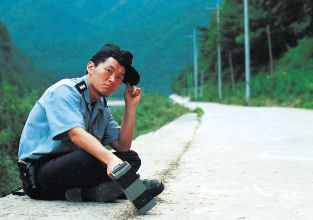 The Wolf Returns starts off like a formulaic action-comedy, a cops-and-robbers version of My Teacher Mr. Kim, but soon mutates into a strange species of its own, a quirky comic thriller-buddy film with wonderful bits of characterization, a sort of 70's rhythm-and-funk sensibility (Is that wah-wah guitar on the soundtrack in the final scene?!) and decidedly lopsided sense of humor. Whereas the movies like Mr. Kim and The Way Home used the remote countryside as a backdrop for the metropolitan characters to rediscover their inner selves, The Wolf Returns assumes a more impartial, or perhaps more nonchalant, attitude about the metropolis/hinterland dichotomy. Director and screenwriter Ku Ja-hong pokes fun at both the rustic country life and the jet-set city life: he does not sell short Jeong-sik's very real desire to be a city cop.
Yang Dong-geun's craggy, bulldog noggin gets a wonderful workout here (especially in a series of close-ups spiced with the mock-film noir voiceovers), but his performance is greatly enhanced by the tit-for-tat give-and-take with Hwang Jeong-min. Hwang, usually cast as soft-spoken, inwardly directed characters, lets loose with a terrific Smokey Bear grin on his face, stretching and bending his limbs with the suppleness and energy of a Max Fleischer cartoon figure. Their verbal sparring, Hwang shooting down in a pronounced (hilariously polite-sounding) Kangwon Province accent Yang's desperate, Tommy-gun delivery of one dumb idea after another about how to attract criminals to the village, is simply great to listen to.
The supporting cast is also terrific, bolstered by the screenplay that swindles us into expecting the typical character arcs only to pull the rug from under our feet. For instance, you think that the local tow-service-owner cum two-bit racketeer Kwang-su's (Jo Hee-bong, Chang Jin-young's lecherous superior in Singles) flirtation with Jeong-sik's girlfriend Doo-mi (Kim Hyeon-jeong, Bloody Beach) will result in him trounced in the butts by Jeong-sik, but their "love triangle" is resolved in a deadpan, "peaceful" way that actually grants Kwang-su a measure of respect and has Doo-mi eat and have her cake too. The art thieves are played by three of the most distinctive supporting actors working in Korean film today, Oh Kwang-rok, Oh Dal-su (both should be instantly recognizable to those who have seen Oldboy) and Yu Seung-mok (Saving My Hubby), who get to show off their theater-trained acting chops. I don't know about you, but for me, just watching Oh Kwang-rok crumple his face and proclaim a simple line like "It's a fake" in his inimitable Hamlet-sucking-lemon delivery ("It's A. Fey-kh.) is enough to get me rolling on the floor.
Even though The Wolf Returns has no ambition beyond being a genre-savvy, feel-good entertainment, Director Ku deserves some recognition for his inventiveness and wit. Even the title is not what it initially appears to be, that is, the "wolf" is not a metaphor for Cheol-gwon. What it really means I leave you to discover on your own, but unlike some Korean critics I did not mind the interjection of this "special character" into the narrative. It is entirely consonant with the whacked-out tone of this charming doozie of a film. (Kyu Hyun Kim)

In western countries, ballroom dancing often evokes images of graceful, aristocratic couples twirling in luxurious settings. In South Korea it is quite the opposite. For decades it has been considered a sordid, morally dubious activity for philandering housewives and slick, scheming men -- who sometimes swindled large bundles of cash from their partners. Ordinary citizens considered the "cabaret bars" where such dancing took place to be a direct threat to the institution of the family. It was not until the late 1990s that a younger generation picked up the hobby abroad and re-introduced it in Korea under the new name of "dance sports," where it is now becoming increasingly popular.
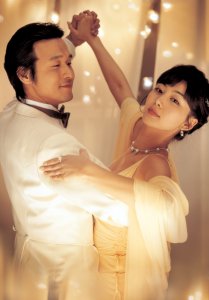 Dance With the Wind, adapted from a 1999 book by acclaimed novelist Ji Seong-sa, tells the story of a man named Poongshik who, having fallen in love with dancing, plunges headfirst into this unseemly world. Torn between his idea of dance as art and a society that won't accept such ideals, Poongshik ends up dragged deeper and deeper (willingly or unwillingly) into a corrupt world he never intended to inhabit. However after he seduces the police chief's wife, a female detective named Yeonhwa is assigned to go undercover to collect evidence against Poongshik that will lead to his arrest. After the two get to know each other, Yeonhwa asks Poongshik to teach her how to dance.
Dance With the Wind is the directorial debut of Park Jung-woo, who probably ranks as Korea's most famous screenwriter. The man behind such famous stories as Attack the Gas Station, Last Present, Kick the Moon, Break Out and Jail Breakers takes a departure from the slapstick comedy of his previous works to present a nuanced and funny account of a self-proclaimed artist who will never be recognized as such. Park shows a particularly fine grasp for comic details, and watching this film makes you look forward to seeing what kind of projects he will go on to direct in the future.
Popular actor Lee Sung-jae portrays Poongshik as being both suave and passionate about his art, though perhaps a bit naive. He appears together with debut actress Park Sol-mi (who appeared in the TV dramas All-In and Winter Sonata) and everyone's favorite supporting actor Kim Soo-ro, who brings quite a few priceless moments to the film. Actresses Lee Kan-hee and Moon Jeong-hee are also quite memorable as two of Poongshik's many dance partners. Most impressive, though, is how good everyone looks while dancing. Aside from one minor character (the young woman at Poongshik's first dance school), none of the cast members are professional dancers, but four months of intensive training prior to shooting has resulted in some fabulous-looking moves.
With a few notable exceptions such as Singles and Once Upon a Time in a Battlefield, last year it seemed that Korean comedies had fallen into a rut. So far, 2004 has been more successful in moving away from the formulaic slapstick/funny-accent comedies to give us something a bit new. Cheers to the people behind Dance With the Wind for giving us a stylish, sexy and enjoyable film. (Darcy Paquet)

A young con artist Chang-hyuk (Park Shin-yang) is killed in a car crash, after snatching five billion won from the Korea Central Bank. The reconstruction of the crime (the original Korean title) by the police reveals that Chang-hyuk was operating in partnership with the veteran conman Mr. Kim (Baek Yun-shik) and that he had named his brother Chang-ho (also played by Park) as the recipient of a massive life-insurance indemnity. Believing that Chang-ho holds the key to the whereabouts of the booty, Mr. Kim's girlfriend In-gyung (Yeom Jeong-ah) befriends him. But neither she nor Mr. Kim is quite prepared for the truth behind Chang-hyuk's con game.
 The Big Swindle is a fine example of a caper film. The subgenre's lineage embraces such disparate examples as the French noir classics (Jules Dassin's Rififi [1955] and Touche paz au grisbi [1954] featuring the immortal Jean Gabin) as well as the big-budget Hollywood productions that are part tourist travelogues and part vanity-fair star vehicles (the original Ocean's Eleven [1960], Topkapi [1964], How To Steal A Million [1966] with Audrey Hepburn). When superbly done, a caper film can be almost unbearably entertaining. I still remember the two young women sitting in front of me agitating themselves into tears, when Robert Redford was shockingly gunned down by Paul Newman in The Sting (1973), and the roar of disbelief and laughter that filled the theater one minute later.
The film is meticulously constructed, sharply designed, and, best of all, smart as hell. Writer-director Choi Dong-hun keeps the action fast and snappy, following the jazzy rhythm of his screenplay, full of endlessly quotable lines and wholly believable details and character traits (At one point during the planning session, a character blurts out, "How many years do we get in the can if we get caught?" Everyone glares at him and simultaneously spits on the ground to ward off bad luck). One of Choi's amusingly creative touches is the self-reflexive analogy he draws between filmmaking and con jobs. He tweaks our expectations while challenging us to distinguish between the actors playing their characters and the characters acting their assigned roles. In one astounding sequence, for instance, a flashback of a wild bank robbery seamlessly flows into a bank guard's re-enactment of the event.
The ensemble cast is uniformly excellent. As someone who has never made it past the first ten minutes of Kilimanjaro, overwhelmed by Park Shin-yang's spittle-flying histrionics, I was a bit worried about him taking on a dual role again. However, Park seems to have figured out how to modulate his quasi-Method acting style since The Uninvited. He is charmingly sneaky as Chang-hyuk and believably mousy, even touching, as his bookworm brother. He gets to speak excellent Russian as the latter, too! Yeom Jeong-ah (Tale of Two Sisters) is the requisite femme fatale, lithe and cool, but with an unexpected twinkle in her vampish, Siamese cat eyes. Other familiar faces include Lee Mun-shik (Once Upon a Time in a Battlefield), Pak Won-sang (Waikiki Brothers, R-Point) and Cheon Ho-jin (Doll Master), cast against type as a dogged but befuddled detective.
However, the movie belongs to Baek Yun-shik (Save the Green Planet) as Mr. Kim, who can switch his identities with the aplomb of a traveling businessman adjusting his tie in a hotel restroom. Baek masterfully adds a layer of pathos to his portrayal of this debonair, high-class scoundrel. Mr. Kim is a vainglorious peacock, who nonetheless takes great pride and joy in his ability to hoodwink other human beings, all the while suppressing the anxiety that age and changing times would someday catch up with him. When he pulls a shotgun out of the cabinet and barks, "It's okay to be ugly when you are old!" Baek makes the delivery exhilarating and melancholy at the same time.
If I think The Big Swindle stops short of being a masterpiece, it is because I would have preferred the film to go beyond its cleverness and peer more deeply into the inner workings of the characters. The final reel generates tremendous suspense less from our anticipation of the actual outcomes of the con game and more from our interest in the possibility of the characters overcoming their ingrained instinct to lie and backstab, and trusting one another. It is somewhat disappointing, therefore, when the film reaches its finale with an ironic twist that's more of a clever plot device than an honest confrontation among the characters stripped of their masks.
Possibly the most ingeniously scripted Korean film of the year, The Big Swindle richly deserved its enthusiastic support from domestic viewers and kudos from critics. It is highly recommended to anyone looking for Korean films that break away from the stereotypical molds of weepy melodramas, haughty arthouse hits and "extreme" exotica drenched in sex and violence. (Kyu Hyun Kim)

The young action-meister Ryu Seung-wan's third feature film following the searing Die Bad and snazzy No Blood No Tears was one of the most highly anticipated films of 2004. In a reversal of the fortune that greeted No Blood No Tears, overwhelmingly supported by critics but ignored by the audience, Arahan was a relative commercial success at around 2 million tickets sold domestically, but drew mixed reviews. Some critics were obviously disappointed to find in Arahan an unabashedly commercial film operating within the perimeters of the Asian action genre, minus the spurts of dark, realistic violence and artistic temperament in his previous works.
 Sanghwan (Ryu Seung-beom, Conduct Zero, No Comment) is an earnest but scared-y-cat traffic cop, abused left and right by low-rent thugs. He gets accidentally embroiled in the lives of the Seven Masters, the secret guardians of justice, whose leader Ja-un (An Sung-ki, Nowhere to Hide, Musa, Silmido) suspects that Sanghwan has a potential to become Maruchi, an enlightened master of martial arts. Sanghwan, to the annoyance of Ja-un's tomboy daughter Eui-jin (newcomer Yoon So-yi), agrees to be trained in martial arts. The plot thickens when the workers at an excavation site accidentally releases the renegade Master Heug-un (Jeong Doo-hong). Can Sanghwan and Eui-jin attain the status of Maruchi and Arachi in time to defend the city of Seoul against Heug-un?
The best way to approach Arahan is to consider it as a shrewd hybrid of the updated kung-fu wire action extravaganza and a modern superhero comic adaptation, a mutation of Steve Chau's Shaolin Soccer by way of Sam Raimi's Spider-Man. It is readily identifiable as a labor of love by a filmmaker deeply immersed in the tradition of Hong Kong kung-fu cinema, especially the early films of Jackie Chan. The film has so thoroughly digested this tradition that the homages to Chan, Yuen Woo-ping and other past masters of Hong Kong cinema may not be readily spotted. But it's there when Ryu Seung-beom smashes a thrown chair in mid-air with a jump-kick, as (the Korean expatriate) Hwang Cheng-li did in the original Drunken Master. It's there when the camera licks the length of the sword that penetrates a character, as in The Eighteen Bronzemen of Shaolin. It's there in the way Sang-hwan "rides" a wooden plank like a skateboard, flashing a devil-may-care, Jackie-Chan-right-before-he-trusses-his-opponent smile.
At the same time Arahan comes with colors and sensibilities uniquely Korean, whether it is the film's clever premise that ordinary working class "craftsmen" are in fact secret masters of martial arts, or the mollifying comic performances that taste warm and hometown like a good 'ol bean paste stew Director Ryu draws out of the film's senior supporting cast. Arahan does not feel like a hodgepodge of Hong Kong film references at all (as it would have been in the hands of a lesser talent) but like a contemporary descendant of the (counter-factual) cross-breeding between Hong Kong and Korean action cinema in the '70s that should have taken place in reality but did not, a few exceptions like Jeong Chang-hwa's Five Fingers of Death notwithstanding.
Ryu Seung-beom has star charisma to spare, but for me it is his attention to little naturalistic details that marks him out, as in his uproarious expression of slow burn when a hapless thug hits him with a chair. His counterpart Yoon So-yi is tall and attractive in an excellently non-cutesy way. As expected, the great An Sung-ki anchors the film with his rock-steady presence but he also totally surprises the viewers with both amazing wire-action moves and wonderfully deadpan comic timing. He is far more interesting as an actor in this slightly goofy role than in Silmido. Jeong Doo-hong once again delivers a solid supporting performance and coordinates the project's insanely complex martial arts moves and wire action. Special mention must also be made of the art direction team led by Jang Keun-yeong and Kim Kyung-hee, responsible for the impressive hangar-size set of the Yongsan altar, cinematography by Lee Joon-gyu and the special effects supervised by Demolition, among others. Except for the scenes obviously modeled after Shaolin Soccer, Arahan's CGI effects are pretty distinctive from both Hollywood and Asian patterns. As was the case with Conduct Zero, the Arahan team's effort to selectively use the technology to generate unique aesthetic effects is laudable, even if a few rough edges still remain.
There have been some criticisms centered on the drawn-out, exhausting climactic fight sequence. I do agree that the overuse of slow motion as well as too many shots of the younger Ryu and Jeong roaring like lions with mouths hanging break up the rhythm of the climactic fight, but I believe that Director Ryu had to work the desire to surpass Yuen Woo-ping or Cheng Hsiu-tung out of his system one way or another. If anything, he seems to err on the side of passion and commitment rather than calculation. For me it was interesting to see, even in this sequence, Ryu Seung-wan's Cinema of Pain struggling to burst out like a geyser of blood from a character's mouth.
Despite its admittedly self-contradictory qualities, Arahan is the most fun I have had with a 2004 Korean film so far (early September). It is deceptively experimental like Ryu's other works and signals a step forward toward the development of Korean genre cinema. (Kyu Hyun Kim)

Woman is the Future of Man may not mark any major departures of style for celebrated auteur Hong Sangsoo, but the filmmaker is still in top form in this tightly-constructed, mesmerizing work. Although it features much of the awkward dialogue and cutting irony that has made Hong's previous films so distinctive, Woman feels in some ways both more shallow and more elusive than the works that preceded it. As such, it is a difficult film to make sense of, unless you have had previous exposure to the negative energy that fills Hong's cinematic world.
 The plot takes place over a 30-hour period in which a university art lecturer (Yu Ji-tae) meets up with an old friend (Kim Tae-woo) who has recently returned from studying filmmaking in the U.S. While eating at a Chinese restaurant, they both start to reminisce about a woman they once dated, who now runs a bar in nearby Bucheon. They end up going to visit her, and despite the fact that she doesn't seem overly enthusiastic to see them again, the three spend the night at her apartment.
Of course what seems like an overly mundane plot still ends up containing much that is hard to pin down. Unlike his previous works, where Hong adopts an overall structure that gives the film a clear symmetry or form, here he largely avoids it. The film takes several unexpected detours, and then feels little need to go back and link them up with what came before. At 86 minutes the film is also quite short, and is bound to leave many viewers feeling like they were told a story with no conclusion. Perhaps Hong felt that in a work filled with people living without meaning or direction, a clearly-structured form would be inappropriate. You might even liken the film itself to interrupted sex.
Despite some differences, the film's two male characters are quite similar in their callous arrogance, as can be seen in a hilarious exchange with a young waitress in the Chinese restaurant. I found the character of Seonhwa, played by Seong Hyun-ah, to be more interesting, even though we get only a rare glimpse into what she is thinking. To a certain extent she may have given up on the world, but she seems to hide a toughness underneath.
As with all of his previous works, Hong's title for this film is an object of curiosity. It is a line taken from an Louis Aragon poem that Hong saw printed on a postcard in a French bookstore. Hong's tongue-in-cheek effort to explain it doesn't leave one feeling any wiser: "As the future is yet to come, it means nothing, and if the future is multiplied by man, the result is still zero. And if woman is the future of man, which is zero, then woman is also nothing..."
After having The Power of Kangwon Province (1998) and Virgin Stripped Bare by her Bachelors (2000) screened out of competition at the Cannes film festival, this year Woman became the first of Hong's works to be included in the festival's prestigious Official Competition. Screened to crowds of press and critics, the reaction was actually quite negative, save for a group of French critics who praised it highly. My personal take on this is that, if you haven't seen any of Hong's previous works, that you are unlikely to get much out of this one. The movie is also distinctly uncommercial, which only provided more fuel for critics out to pan it.
Perhaps if those critics had researched Hong's filmography, they would have realized that his films are something unique in world cinema. On an aesthetic level, no other filmmaker produces the same weird tempo created by Hong's editing, and the elegance which underlies the awkward surface of his films. This is not where you should look for lectures on social ills or for moving tributes to humanity, but if you want an honest and sober effort to depict something truthful in human relationships, then this film is something you will enjoy more and more with each repeated viewing. (Darcy Paquet)

One of the few bogus things about attending the Far East Film Festival in Udine, Italy, is the fact that I miss the San Francisco International Film Festival. It's somewhat ironic that I miss it because it played a major part in why I follow South Korean cinema. When I first came to San Francisco, they featured a retrospective of Jang Sun-woo's work. And the next year, Im Kwon-taek received the festival's Akira Kurosawa Award for lifetime achievement by a director. Having awarded Im, it only makes sense that the festival would present Im's latest film, Low Life, in 2005. I'm saddened that I'll miss seeing this film on the big screen, since the gorgeous set design would look even more magnificent than it did on my TV.
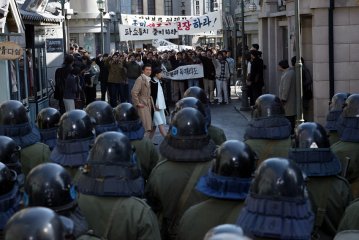 Who better to travail the political and apolitical gangster under and upper world of South Korea in the 50's, 60's, and 70's than Im, a director who was able to maintain a filmography across this entire era and onwards. Heading back to his action genre roots with films like the successful Son of a General franchise, the story begins with Choi Tae-woong (Cho Seung-woo - Chunhyang, The Classic) entering a rival school and beating up its leaders. In response to this humiliation, Park Seung-moon (Yoo Ha-joon) stabs Choi in the thigh and runs away after doing so. Choi then stutter steps the entire way to Park's upper-class house with the knife still embedded. Choi wants the "bastard" to finish the job, that is, pull the knife out of his thigh. Park's father, an independent politician named Park Il-won (Kim Jeong-su), agrees and demands the same of his son. After which, Park's father decides to adopt presumably orphaned Choi into the family, which also includes Park Hae-ok (Kim Min-sun - Memento Mori, A.F.R.I.K.A.) whom Choi will eventually, . . . uhm, . . . marry. Choi and his brother/brother-in-law Park will take different trajectories in their adult paths, Choi down the road of further gangster-hood and Park the path of student activism, although Park will eventually come around to Choi's world when it morphs into crony capitalism within the construction industry. Throughout this tale of Choi's "Raging Years" (the alternative English title), Im weaves the raging political events of the 60's and 70's, such as Park Chung-hee's military coup and surveillance of the populace.
Low Life's primary problems center around how much is packed into it, requiring too many drastic shifts from one scene to the next. Once Choi comes around to paying proper 'filial devotion' to his biological mother, (turns out he wasn't really an orphan), this moral statement is just dropped in the film and never returned to. We know nothing of Choi's mother after this supposedly important meeting. As a result of so much to tell, too much of it is told rather than shown, and some of the emotional transitions seem less plausible, even unintentionally comical, such as when Choi punches his mentor, Oh Sang-pil (Kim Hak-joon, a veteran musical theatre performer), to keep him from committing suicide. Still, those familiar with Im will note his trademark scene where we focus in on the anguish of a woman's face while having sex or giving birth. Here we have the latter, the sight of which Choi equates with divinity.
Choi is a character many might be incapable of identifying with since he's prone to yell out misogynistic threats that I can't even desensitize from long enough to type here. Perhaps Im presents a better portrayal of the 'real' gangster than we have found in Korean comedies or action flicks. But, one doesn't have to like or admire a character to identify with them. The protagonist in Peppermint Candy, another film where a character who exists outside politics is Forest-Gump-ed into Korean history, is a good example of accomplishing such difficult audience alignment with a loathsome character. Low Life doesn't accomplish the same.
Yet, there is much surrounding Low Life that fascinates me. I can neither confirm nor deny the accuracy of the representation of the period, but art director Joo Byung-do's sets and prop master Kim Ho-gil's artifacts replicating the streets and lives of 1960's Myungdong are truly wonderful. In particular, I found myself wishing Q was there next to me while watching so I could ask the significance of each Korean movie poster and marquee that briefly appeared. (I know the significance of the films of the two Jameses - Dean and Bond.) Im's portrayal of movie censors is quite intriguing as well, particularly due to Low Life's own exclusion and inclusion of scenes similar to the two we screen ourselves which are eventually forced out by censors of the movie made within the movie. A sex scene is cut out along with a film critical of American military occupation. Rare for a recent Im film, Low Life itself has no sex scenes save the one eventually cut out by the censors. Whereas, Im's representations of American occupation, ambiguous scenes of GIs walking around with Korean women in the background, remain in Low Life while the direct, negative critique in the film within the film is stricken by the censors.
This portrayal of the censors had me recalling Kim Hong-joon's video essay, My Korean Cinema, wherein director Kim reflects on the censored cuts of Ha Kil-jong's March of Fools. And Kim actually makes a brief appearance in Low Life as a man accused of being a Communist by a taxi driver. This scene places him in a police station amongst young adult men who are forced to cut their hair, a reality of the 60's referenced in March of Fools. In addition to this male humiliation, Im includes the treatment young women received from cops measuring the height of their skirts off the knee.
To me, it is all that happens around the narrative that is most engaging about Low Life. Outside of the excellent climactic scene where the connection between politics, student activism, and Choi's thuggish business practices is underscored, it is the signs and symbols of this Korean era that stay with me most. Im's reputation precedes him here, thus leaving me disappointed with number 99. I just hope everything jells better for number 100. (Adam Hartzell)

There's something to be said about bad movies. That something is that they can underscore what makes a great movie. Bad movies bring heightened attention to the importance of certain aspects of film such as narrative, editing, and emotional subtlety. Although lapses in the narrative fall under the responsibility of the screenwriter, weak editing the editor, and lacks of emotional nuance the actors and actresses, all of these are also under the greater responsibility of the director to make sure each combines into a satisfying whole. A director needs to instruct the editing staff on how to structure the takes, she needs to work with the screenwriter to address any narrative obstacles that arise during filming, and he needs to utilize each actor's strengths without exposing their weaknesses. Clementine is a lesson in much of what makes a bad movie and the onus of responsibility regarding its failure lies greatly in the hands of director Kim Du-yeong.
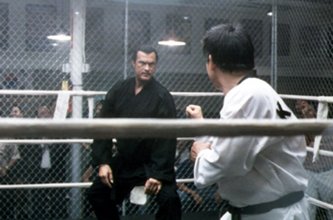 The basic plot revolves around fictitious former tae-kwon-do champion Kim Jun-lee (Lee Dong-jun) whom we are initially told ended up a single father due to the death of his daughter Sa-rang's (Eun Seo-woo of Phone) mother while giving birth. Kim's violent spontaneity make it difficult for him to hold a job as a cop and eventually he gets rounded up with a group of gangsters which leads to the eventual kidnapping of Sa-rang to force him to compete in an illegal cage match. Although there's a major puzzle piece poorly fitting into the plot involving a prosecutor (Kim Hye-ri), a woman with a past revealed via the most outrageous of explanations, the film weakly builds towards the cage match. That cage match is with Jack Miller, played by Steven Seagal. Obviously, his "star" factor was used to merely tease viewers, because he doesn't really enter until the end, and when he does, it is so unbelievably anti-climactic you wonder why he's there at all. His fighting skills are never fully utilized. In fact, the spectacle of tae-kwon-do is not used as one would expect in this film. Our less than darling Clementine could have saved itself as a film made for simply visceral pleasure, like any other film within the porn genre, a nomenclature net I cast wider than most and one I do not necessarily intend negatively. Seagal doesn't even seem to try to act at all, as if he regrets caging himself within this horrible film, horrible even considering his filmography. Whereas Seagal's performance is poorly emoted, the rest of the cast, from our lead to Kim Hye-ri to even little Eun, are directed towards over-emotive heights to the point of being melodramatically pornographic.
It didn't need to be this way, because Clementine begins with a topic ripe for exploration. The beginning of the film alludes to an incident from the 2002 Winter Olympics in Salt Lake City, Utah, where South Korean skater Kim Dong-song was disqualified for improperly blocking United States skater Apolo Anton Ohno. The referee's decision resulted in Ohno winning the gold medal. The world was reminded of this incident when Ahn Jung-hwan, after scoring the tying goal during South Korea's match with the United States in the 2002 World Cup, mimicked a speed skater. To the delight of Ahn's home fans, this performance was meant to mock Ohno's controversial win. In Clementine, we have our 'hero' Kim Jun-lee losing his tae-kwon-do gold medal round to the U.S. on what is portrayed as outright fallacious judging. Little did director Kim know while making this film that South Korea would again find itself feeling cheated at the expense of the U.S. in the 2004 Summer Olympics when judging mistakes led to a gold medal being awarded to U.S. gymnast Paul Hamm over Yang Tae-young in the male all-around. Regardless of which way your knee jerks, seeing the reactions to these incidents as evidence of Anti-Americanism or American Imperialism, these incidents would provide wonderful grist for a cinematic mill. Yet, director Kim doesn't harvest this beginning for anything more than extremely weak motivation for Kim Jun-lee's fight at the end of the film. Such demonstrates the film's major flaws - plot points brought in and dropped out with haphazard development, leaving the viewer wondering where the hell this film is going to go next.
The question arises with bad movies, however, if such awfulness was intended or not. As the old adage goes, a bad movie can be so bad, that it's good. A bad film then steps into camp and other forms of parody that provide entertainment through the laughter surrounding the mere ridiculousness of it all. Clementine has so-bad-it's-good moments, such as the totally random appearance of actor Lee Bo-seong briefly reprising his role as Inspector Lee from Two Cops II and III and the bizarre declaration of love to Seagal by Sa-rang during the credits. But also within the credits is a didactic narration demanding all families - apparently even insane ones like the one presented here - should stay together. This moral at the end suggests that director Kim was trying for more than he and his ensemble were capable of in Clementine. Only time will tell if Clementine will ever reach the point of awfulness where it transcends into the realm of classic B-Movie fare ala Ed Wood. Presently however, all that remains is a lesson in how bad a movie can be to remind us why we treasure the great ones, . . . or, jeez, even the simply OK ones. (Adam Hartzell)

Aside from Taegukgi, another of the year's most highly anticipated movies was Windstruck. Within a short period of four weeks, it had garnered a box office of 2,229,000 admissions, and become one of the top four domestic movies of the year. It is no wonder that the show would be a big hit, especially since the director is none other than Kwak Jae-yong, who was responsible for the success of the 2001 hit, My Sassy Girl. Also, the main stars -- Jeon Ji-hyun, one of the most popular actresses in Korea and Asia and up-and-coming actor Jang Hyuk -- contributed to its success.
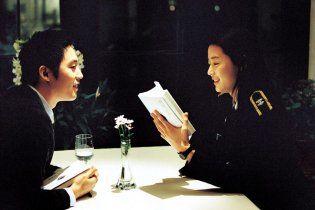 In fact, some critics have retorted that Windstruck is just another sappy version of My Sassy Girl. This is true, to a certain extent. However, you could say that Kwak's style of directing has been recombined to give a new bittersweet formula. It seems that Kwak has drawn from his experience in directing comedies such as My Sassy Girl and melodramas such as The Classic, and decided to try both formulas in the same project. The result you get is: Windstruck!
If you are looking for a good comedy to watch, Windstruck might not exactly be the one to provide you with the most laughter. Switching between sappy and hilarious moments, this movie brings you on a roller coaster ride of outbursts of different emotions. The role played by Jeon Ji-hyun is a happy-go-lucky police officer, whose sole reason of joining the police is because that was her dead sister's ambition in life. Jang Hyuk plays a high school teacher who had lead an ordinary life until the day he met Jeon's character. Instead of a sedentary life as a teacher, he finds himself entwined in her day-to-day policing activities such as chasing after criminals.
In an interesting opening, the movie has Jeon, standing at the top of a building, attempting to commit suicide, with Jang Hyuk as the background narrator. It then moves on to a flashback and switches to a narrative mode to tell the story of the preceding events which eventually lead to the opening scene. Throughout the narration, we witness the encounters of our two protagonists and how they eventually end up together. There were a couple of hilarious moments and scenes which tickle the audience's funny bone.
However as the story slowly proceeds, it feels that it is being too far-fetched to accommodate so many ideas. One might feel that the plotline is ridiculous at many times, and might start wondering at some point if the film is a fantasy, ghost story, romance or an ultra-dramatic melodrama. Occupying an array of so many genres, Windstruck could be said to be one of a kind. Despite that, Kwak has attempted to insert too many of the ideas that he used in My Sassy Girl, especially the last scene, which entirely spoils the movie. (Kit Lim)

One of the biggest disappointments of the 2004 summer season has been the terrible under-performance of the horror film genre. Aside from the critical and box-office success of the Viet Nam-themed R-Point, (To Catch a Virgin Ghost did fairly well too, but it is, strictly speaking, a comedy) this year's straightforward horror films performed between mild disappointments and dismal failures in box office terms, and were absolute disasters in critical terms. Interestingly, all these films seem to have failed for different reasons, aside from possibly one common denominator, the bad screenplay.
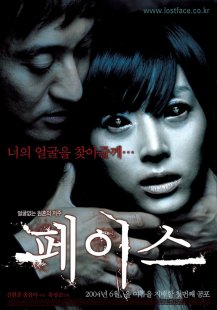 Face is at least based on an interesting premise. Hyun-min (Shin Hyun-joon, the sourface hero of Bichunmoo [2000], quite convincing as a misanthrope) is a specialist in recovering a dead person's identity by reconstructing his or her face. (Fans of mystery films might recall that facial reconstruction also figures in the Michael Apted thriller Gorky Park [1983]) He reluctantly takes on the job of identifying the victims of a horrid serial murder case. The victims have turned up as skeletons, with all flesh dissolved away with some chemical solvent. Sun-yeong (Song Yun-ah, Jail Breakers) joins him in the investigation as a junior partner and they develop a friendship. Meanwhile, Hyun-min is plagued by the visions of a long-haired, funeral-clothes-garbed female ghost, who seems to have apprenticed in ghosting skills under Sadako from Ring (1998). She pops up in his bathroom. She pops out of a puddle on the living room floor. And so on. Darn, it's so scary.
First and foremost among the movie's many problems is that its plot makes no sense whatsoever. The screenplay credited to Pak Cheol-hee and three other writers tries hard to plant red herrings and manipulate the viewer's expectations, only to hinge the entire film on a ridiculously flimsy "twist" ending. Looking at Hyun-min crawling away in abject horror from the "final revelation," you will either feel insulted, like being subject to a sales pitch by some beer-smelling cretin in a bar, or hang your head in embarrassment. This revelation comes from absolutely nowhere (let's not even go into the numerous lapses in logic required for the characters to arrive at this point) and yet is utterly predictable: it is a fine example of how the obsession with a "surprise ending" can ruin a screenplay. It might not have mattered that much if director Yu Sang-gon chose to make the film in a deliberately unrealistic style, perhaps in the manner of some Italian gialli. However, Yu chose to make the movie in a naturalistic mode with overtones of a police procedural, accentuating the senselessness of the plot.
The true shame is that Face is in fact a polished production with a lot going for it in the technical end. Choe Ji-yeol's cinematography, Lee Han-na's music (especially her use of the wailing female vocals) and the veteran Pak Kok-ji's editing are all proficient and envelop the film in professional sheen. Face also does include several effective scenes, such as the long, dialogue-less sequence where Hyun-min uncovers a key piece of evidence in a sand quarry near the Han River. Here Yu keeps things quietly menacing without resorting to herky-jerky camerawork that mars the similar sequences in many other movies.
In the end, I believe the biggest problem with Face is that director Yu Sang-gon was simply not interested in making a horror film. It is one thing to attempt to make a horror film that's different: it is quite another to be saddled with a screenplay so chock full of horror-film conventions and refuse to honor them. I was surprised to learn that Yu was responsible for the wonderfully droll and heart-warming short film Superman in Early Summer (2001). Unless I have missed another one directed by Yu that's an in-your-face gorefest, this is not the kind of short based on which a director is given a feature-length project involving the vengeful ghost of a woman and a vat of chemicals in which human bodies are dissolved.
Indeed, there is a sequence in Face where a character falls into a tub filled with chemical solvent, and Yu films it from a bird's-eye-view, totally distancing the viewers from the vista, and hurriedly moves ahead, as if he is ashamed to have to dwell on such crass, exploitative materials. However, as Stephen King has put it, after all the delicate fine-tuning of plots and characters are done, the writer/filmmaker of a horror film must "don the monster mask and go booga-booga." What's the point of trying to make some moving human drama out of a material that screams in block letters, "Faceless Ghost!" "Melting Human Flesh!" "Scary Ain't It?" It's like a producer giving Martin Scorsese Nicolas Pileggi's screenplay for Goodfellas and asking him to make a musical out of it: "You know, like you did with New York, New York, only with real wiseguys this time. De Niro can sing, can't he? Whaddaya say, Marty?"
I have to chalk Face up as another disappointing instance of talented Korean filmmakers just not getting the point of a genre film, be it horror or science fiction, while putting so much energy and skills in rigorously reproducing its form from the superior examples from outside Korea. (Kyu Hyun Kim)

Comic romances are a dime a dozen in Korea, and anyone who has spent much time watching Korean cinema will recognize the basic plot structure: young, good-looking (middle class or rich) man meets cute, spunky woman by chance; they go through some outlandish experiences together, and then eventually the threat of something sad pushes them together in a final burst of melodrama. When they're well directed, such movies can be a lot of fun. If not, they're instantly forgettable.
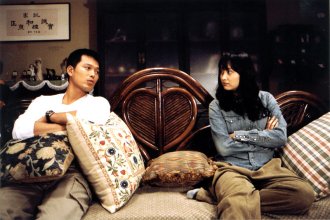 Someone Special seems to start off all wrong. Our male lead is neither cute nor particularly young; the role is played by Jeong Jae-young, better known for acting nasty and brutish in films like Silmido or No Blood, No Tears. His love interest is played by actress Lee Na-young (Please Teach Me English), who looks fantastic in the cosmetics ads plastered around Seoul, but here she's clumsy, badly dressed and mumbles a lot. She's not spunky, she's just weird. To top it off, the film's sock-it-to-you tragedy comes less than two minutes after the opening credits, before we even get to know anything about the main character. What was Jang Jin thinking?
Of course, I'm joking. Someone Special is line-for-line more charismatic than even the most successful of the formula films described above. Our main characters -- a moody, lovesick baseball player and a woman who seems unnaturally attracted to him -- seem real because we rarely come across anyone similar in Korean cinema. They are both more ordinary and more distinctive than the typical movie couple.
More than anything, the film is well-written. Up until now, the career of film and theatre director Jang Jin has been made up of two separate currents: a physical, talky humor in the films he's directed himself: Guns & Talks (2001), The Spy (1999), and The Happenings (1998); and more overt melodrama in the screenplays he has written for other directors: Ditto (2000), A Letter From Mars (2003), and "The Church Sister" from No Comment (2002). Only in this latest film does he seem to fuse the best of both tendencies. It's a bit quieter than his previous works, but his distinctive humor is as sharp as ever. And without intending to sound patronizing, I can say that Jang's latest work feels more mature, as if life experiences underlie the bittersweet humor portrayed onscreen.
One thing that might strike some viewers as odd is the way the movie sometimes crosses into outright sentimentality, without clear markers to show that it is meant to be ironic. Our hero seems to ask everyone he meets what love is, for example. They often humor him with a serious response. If the film pokes fun at sentimentality, it nonetheless commits the same sin itself from time to time. Personally, I like this -- you could argue it makes the film's point of view more complex.
My favorite part of Someone Special (the original Korean title means "A Woman I Know," or "A Woman Who Knows") is a film-within-a-film that we catch during our couple's first date. Acted out by Jeong and Lee themselves, the oh-so familiar plot and sarcastic narration is a glorious, cutting sendup of contemporary Korean cinema. Just as Jang seems to be laughing both at and with the characters in Someone Special, his skewering of Korean melodrama in this segment can probably be taken as equal parts ridicule and affection.
And I can't close this review without a small cheer for the acting. Before the film's release, hardly anyone I spoke to believed that Jeong Jae-young could pull off the part of a romantic lead. The unconventional casting must have had investors nervous, but Jeong's performance ended up being one of the film's biggest talking points. The part of Yi-yeon meanwhile was written with Lee Na-young in mind. She hesitated before taking the role -- perhaps not wanting to look too unglamorous in two films in a row -- but to her credit, she signed on and did a standout job. (Darcy Paquet)

This sophomore effort by director Park Heung-shik (I Wish I Had a Wife) has all the markings of a crowd-pleasing romantic comedy. The big draw is top star Jeon Do-yeon taking on a dual role for the first time, paired with Pak Hae-il (hot from Memories of Murder).
Na-young (Jeon Do-yeon) is a pretty but demure travel agent, living with her parents. Her mother Yeon-soon, played by the veteran actress Ko Doo-sim (Saving My Hubby), is a former haenyeo (female divers who make a living by catching shellfish) and now a back-scrubber in a public bath. She is a barely literate, tough-as-nails fiftysomething who spits everywhere and cusses like a macho gangster in an Oliver Stone movie. (The film opens with a cleverly staged sequence in which Yeon-soon is seemingly grieving over someone's death during a funeral service, only to be revealed as accusing the dead man of "dying irresponsibly" after having borrowed her husband's money) Na-young is desperately embarrassed by her mother's shameless, money-grubbing behavior and equally disillusioned by her father's refusal to fully engage with his life. When her father, sentenced to a terminal disease, disappears, Na-young traces him back to Yeon-soon's hometown, a remote island in Southwest (Even though the haenyeo is usually associated with Cheju Island, director Park made the characters converse in Cholla Province dialect. The authentic Cheju Island dialect would have been nearly incomprehensible to most Koreans). There, she is caught in a time slip, a la Peggy Sue Got Married (1986) and befriends her own mother as a young diver, courted by the younger version of her father, a postal worker.
 When I first saw My Mother, The Mermaid, I was greatly impressed by Jeon Do-yeon and Ko Doo-sim's powerhouse performances, but a bit disappointed by the film itself. At the initial glance, it appeared too gentle and too dependent on its brilliant actors to carry the film forward, making half-hearted attempts at squeezing the viewer's tear ducts but not really presenting a powerful narrative in command of the viewer's undivided attention.
The second and third viewings have not changed my opinion that the whole of the film seems less than the sum total of its parts. Fortunately, they have made me realize that the pleasure derived from the parts is considerable. Freed from the need to follow the plot and chart the character arc, we can sit back and let our hearts resonate with the stirringly intricate and nuanced performances of the principal performers.
I hate sounding like a skipping CD, but Jeon Do-yeon is absolutely brilliant here as she is anywhere. She is no less impressive essaying the role of soft-hearted and introverted Na-young than playing an uncultured but spunky Yeon-soon. It would have been so easy to turn the former into an annoyingly self-centered twerp, and the latter into a cartoon caricature defined by her funny accent, tanned skin and "cute" pigtails. Jeon resists all the easy choices and paints her characters in layers and layers of shadings, so much so that the range of her performance is difficult to appreciate in just one viewing.
Pak Hae-il is dashing and handsome, devoid of the lethal and metallic beauty that he displayed in Memories of Murder. However, his presence is still so striking that we have trouble believing that he would age into the spineless old man depicted in the film: this disjuncture between Jin-guk (father)'s young and old selves is one of the film's major weaknesses.
Ko Doo-sim is also simply wonderful, matching Jeon stroke by stroke in technical adeptness and restraint. She projects life force of her own whenever she is on screen, and when Yeon-soon tearfully berates her husband for not standing up to his illness, Ko effortlessly communicates a lifetime of unarticulated disappointment, pathos and love without a shred of affectation.
It must be admitted, too, that the sensitive direction by Park Heung-shik and the warm and effusive cinematography by Choe Yeong-taek (Oasis, Volcano High), almost entirely done with natural lighting, collaborate well with the actors in mounting effective set pieces.
Despite its star wattage, My Mother, The Mermaid is neither a mainstream romantic comedy nor a well-calculated tear-jerker. Instead, it turns out to be a soulful tribute to motherhood, especially those Korean mothers who have foregone respect and understanding in their efforts to survive and care for their (indeed often totally useless) husbands and (indeed often totally unappreciative) children. Perhaps the best thing about the film is that it is not one of those disgustingly hypocritical melodramas that portray the grown children weeping over their (dead) mothers (and the meals that the mothers cooked for them, like the indentured servants that they were), whom they have exploited and kept silenced throughout the latter's lives.
As played by the beautiful-in-her-crow's-feet Ko Doo-sim, this Mother does not need the patronizing "appreciation" from her children, thank you very much. (Kyu Hyun Kim)

The Han sisters -- the elder, married Ji-young; bookish middle sister Sun-young and the free-spirited Mi-young -- find the placid surface of their lives upturned with the arrival of Soo-hyun, a suave sweet-talker who seems to be the perfect man. Mi-young first discovers him at a club and brings him home to meet the family, however he ends up serving as a catalyst for the unleashing all of the household's repressed emotions.
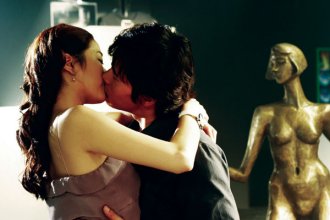 A remake by Jang Hyun-soo (Ray Bang) of Gerard Stembridge's Irish feature About Adam (2000), Everybody Has Secrets is an attractive, slickly-packaged feature that highlights the development of Korea's star system. Lee Byung-heon (JSA, A Bittersweet Life) is probably a leading choice for the best-looking man in Korea, and this film is structured almost as an homage to his sex appeal. Lee plays Soo-hyun in such a way that his famous so-called "killer smile" remains a mystery right up to the final scenes.
As for the women, although Kim Hyo-jin (Legend of the Evil Lake) lacks some charm as Mi-young, the elder sisters steal the show. Choo Sang-mi (Turning Gate, A Smile) as the married Ji-young has long been known for the intelligence and sensuality she brings to her roles, and here she slowly and elegantly allows herself to come under Soo-hyun's spell. Meanwhile Choi Ji-woo -- a huge star in neighboring Japan after the success of her TV drama Winter Sonata -- puts her considerable talent on display in portraying a woman whose deeply-buried passions suddenly fight for expression.
Released in the peak summer season where it was quickly overwhelmed by competition from more popular Hollywood and Korean titles, Everybody Has Secrets was arguably more successful in Japan, where it turned a modest-sized release into a more sustained box office performance. As such, the film represents not only a showcase of the Korean star system, but also an example of how Korean films have come to rely ever more on audiences in Japan.
If the film ultimately falls a bit short, this is perhaps because it relies a little too much on the plot's catchy but thin central premise. It takes more than good acting to create an engaging and memorable comedy, and it would have been nice if there was a bit more happening in a narrative sense. Still, several highly amusing scenes from this film stand out in the memory, so it's probably worth a watch if one's expectations are kept in check. (Darcy Paquet)

Dear Editor, I am ba~ack!
Yes, it's Yours Truly, the dippy-and-trippy-but-not-uppity stand-in for our mutual associate, Professor Kim. He's had too much Caravella limoncello mixed with champagne during the New Year's Eve. From the look of it, I might have to take over for a couple more reviews.
BTW, I hope there weren't any protests from the Matrix otaku constituency over the little remark in my last contribution. Let me post a correction here, if you don't mind. I never meant to call Matrix Relocated a glorified sunglass commercial. What I meant to say was, it's a sunglass and leather wardrobe commercial. Evidently I did not pay sufficient attention to the comprehensiveness of the flick's fashion statement.
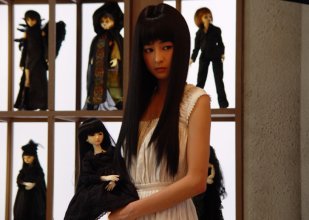 All right already, Professor Kim, I am the writer here, and I can darn well start my review with any length of pointless chitchat. Stop screaming! Shoo! Go play with your cat!
Now, what have I got to say about Doll Master?
Doll Master takes a hoary horror film cliche especially well-developed in Japanese cinema, a living doll, and tries to jazz it up for contemporary Korean viewers. For that purpose, director/writer Jeong Yong-gi and the producers seized upon the ball-joint dolls that have articulated limbs and anime-style big eyes. First developed in Germany, these dolls have since acquired some disturbing air of sexuality in the hands of avant-garde European artists like Hans Bellmer. More recently they've become all the rage in Japan. Miike Takashi's "Box" segment from Monster... Extremes (2004) and Oshii Mamoru's Ghost in the Shell 2: Innocence, (2004) to cite but two examples, present the darker and taboo-shaking images of these dolls. It turns out that quite a few Korean youngsters (and maybe oldsters, too) own these ball-joint dolls, to the extent that the filmmakers apparently considered them a core group of viewers for this project. These dolls are indeed adorable and beautiful, strangely lifelike even though the proportions of their anatomy are all wrong, and yes, they can be major-ly creepy.
Instead of mumbling like Marlon Brando with cotton-balls in his mouth, I'll cut to the chase. Doll Master is pretty badly put together. In some sections it is flat-out incompetent.
Characters in this movie are not just dumb, they are irredeemably, incorrigibly stupid. Near the climax, Hae-mi (pretty but harried Kim Yu-mi, Phone), all torn and bleeding, gets one chance to make a telephone call. Instead of calling for the police, fire department, Ghostbusters or anybody else who could conceivably haul her butt out of the house, who does she call? Her mom, so that she could find out her childhood doll's name, and thus a plot point could receive exposition. That's merely one example. How about the numerous gaffes and "huh?" moments like car keys appearing and disappearing at will, or a laptop computer that mysteriously creeps into the frame in a key murder scene?
The narrative lurches from one set-up to another with the rhythm of a spatula turning over a two-pound hamburger patty in your local diner. The production quality is good overall, but even the doll-motif designs of the house, initially fascinating and riveting, become silly when the filmmakers put a mannequin inside a bathroom cubicle, in place of the lid of a toilet seat. And of course the dummy crunches a poor character into an origami sculpture, while she is taking a dump. What a way to go! As Aunt Liz would have said, "Couldn't you at least wait until nature's call has been answered?"
So is Doll Master a lost cause? Even though comparing it to, say, Tale of Two Sisters would be an insult to the latter, I confess to a measure of affection for the film, thanks mostly to the presence of Im Eun-gyung (Resurrection whatever z-z-z, Conduct Zero). Please, no grumbling about spoilers: with her dinner-plate-sized eyes, chestnut-shaped head, porcelain skin and hooked nose, what else could she play in a movie about a living doll, for Mother Theresa's sake? And this type-casting works. Every scene that generates a modicum of mystery or sympathy has Im in it, emoting with great sincerity. She almost makes the film's Japanese-culture-derived subtext of a beloved inanimate object taking on a life of its own work.
The older supporting cast slogs through the laughable materials with admirable professionalism: Kim Po-yung as the physically challenged doll-maker and Cheon Ho-jin (Double Agent, Once Upon a Time in High School) as her partner are particularly effective.
In the end, Doll Master is probably best marketed to Im Eun-gyung fans, among whom I happily count myself. I am curious how the actual owners of the ball-joint dolls responded to the film, but I bet they would have found Hae-min's horrified on-screen reaction to the living doll pretty dorky. What kind of dweeb wouldn't want to own a doll that can show up as Im Eun-gyung in human form? I know what I would do: instantly get a mortgage on a brand-new doll house, built just for her.
I suppose that's all I've got to say for now. As usual, thanks for your heroic patience with my cuckoo hootings and Prof. Kim's sullen sulkings!
Happy Viewing and Re-viewing,
Yuhn Mi-kuk

Bunshinsaba, the third film written and directed by An Byung-ki (Nightmare and Phone, both starring Ha Ji-won, a no-show this time around and sorely missed), the only self-acknowledged horror film enthusiast among South Korean directors, was one of the dismal '04 Summer horror offerings but has nonetheless managed to snag remake rights (Hollywood seems to have forgotten the concept of "original screenplay" altogether. But what can we say when their idea of a bright new horror talent was Kevin Williamson, the brain force behind Scream and Dawson's Creek? Whatever you may say about Bunshinsaba, it is not nearly as dreadful as, say, Cursed, Williamson and Wes Craven's latest boring-teenagers-in-jeopardy "horror" dud. So perhaps buying remake rights to second- or third-tier Korean horror films is a rational choice for the Hollywood flick-folks after all).
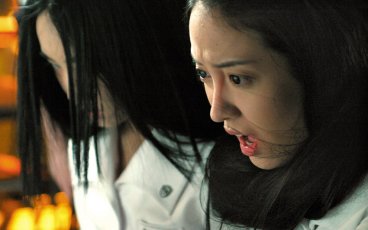 Bunshinsaba cannot be considered a good film by most standards: it is unintentionally goofy, occasionally annoying, makes little sense, and, as is typical with an An Byung-ki film, almost self-consciously generic, with a patchwork-quilt tendency for its key scenes composed of stuff ripped off of other, better movies. Indeed, few could accuse this film of being original. Despite the fact that it is an adaptation from another source, a novel by Lee Jong-ho, the core of the narrative turns out to be a rehash of his early film Nightmare: the Revenge of the Misunderstood Psychic Girl, this time spread over a wider canvas to incorporate the Girl's Mother.
The film stars Kim Kyu-ri (Nightmare, Whispering Corridors) as Eun-joo, a teacher in a girl's high school who keeps seeing a vision of a dead student in her class. Yu-jin (Lee Se-eun with her striking faceted-jewel eyes, previously in Bloody Beach and also seen in the megadrama Daejanggeum), meanwhile, tries the ritual of bunshinsaba (a game of contacting dead spirits via Japanese-sounding incantations: oide kudasai, etc), in the hope of sic-ing the evil spirit against her tormentors in the school. The situation spins out of control when the curse actually works, and her classmates kill themselves or die from suspicious accidents. Eun-joo must uncover secrets buried for thirty years, involving the ghost student and her shaman mother, to save Yu-jin from possession by the dead girl.
In addition to the uninventive story and setup, An's adrenalin-charged, sledgehammer directorial style is cranked up several notches for his latest effort, so much so that at some points the viewer might feel like a human punching bag: there are sequences in which characters literally scream every one and a half minute, continuously. Abandon ye, who enter the Realm of An Byung-ki's Horror World, all Hope for Subtlety or Thoughtfulness of Any Kind!
And yet, I confess to having enjoyed Bunshinsaba slightly more than a recent spate of Korean films with perhaps bigger ambitions or better production values. As a horror film, it has one virtue lacking in so many of its kin: it has no ambition other than to scare the beejesus out of its audience, and pursues this goal with single-mindedness and refusing-to-remain-dead energy that would win a nodding approbation from Michael Myers. An dispenses with pretentious "social commentary," metaphysical mumbo-jumbo and "romantic" subplots that frequently mar other horror films and concentrates on producing goosebumps. More often than not, his efforts fail, but occasionally his patchwork-from-better-films style hits bulls-eye, as in the sequence involving a character's head staring out of a grocery store bag (although it is clearly "influenced" by a similar setup in Tomie).
I wish Bunshinsaba turned out to be a better film than it is. Around the one-hour mark, even my tolerance for horror film cliches, which is considerable, began to wear out due to the movie's relentless whacking of my brainpan. By the time the hooded crowd of villagers (?) show up en masse hoisting burning torches (?!), eager to roast the creepy mother-daughter team alive, the movie pretty much self-destructs like one of those audio tapes in Mission Impossible, hissing sulfurous fumes clogging up my sinus and bringing on headaches. Since the movie has completely failed in making these victims-to-be sympathetic (the psychic girl is presented as an ultra-annoying little murderess who does use her supernatural powers to kill her classmates), it is difficult to get emotionally involved in any of the climactic actions, or resolution to the problem of her reincarnation. To put it bluntly, the mother and daughter psychics are both creepy monsters, and perhaps the villagers were right in destroying them, their outdated fashion sensibility and lack of concern about the fire hazards notwithstanding.
Despite the box office underperformance and savage critical attack on Bunshinsaba, I sill hope that An and his (unfortunately titled) Toilet Pictures continue to churn out horror films. I could always use one, even if it is messy and conventional. I also hope that, after Bunshinsaba, An Byung-ki would finally wise up and employ a good screenwriter, as well-versed in horror films as he is, but who understands the meanings of such concepts as Subtlety and Character Development. (Kyu Hyun Kim)

Every so often in Korea, a director with robust artistic aspirations and less concern for the commercial bottom line finds an unusually supportive (or naive) producer. Tempted by hopes of festival glory, or perhaps anxious to prove their artistic credentials to their colleagues, such producers give their director an artistic blank check in the hopes of getting something special. The results are always fascinating, whether or not they succeed. Think of Jang Sun-woo going through $9 million in shooting Resurrection of the Little Match Girl, or Park Chan-wook realizing his dream project Sympathy for Mr. Vengeance.
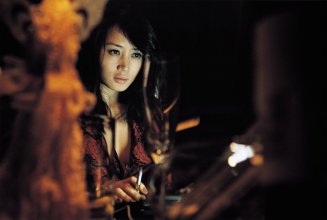 Two years after struggling against a micro-budget, a rebellious crew and an indifferent public to make the critically acclaimed feature Road Movie, Kim In-sik returned to make his second film in a far more supportive environment. Though at just over $2 million it is hardly a big-budget film by local standards, Hypnotized represents a newfound freedom for the director to realize his visual and narrative ambitions onscreen. And if anyone ever doubted that Kim was a filmmaker with a unique style and vision, the first few minutes of this film will convince them otherwise.
Which is not to say that most viewers or critics will necessarily like it. Kim practically redefines the words "over the top" in his opulent interiors, sensational dialogue, big hair, and sudden bursts of noise, color, sex, or blood. Whereas Road Movie inhabited the lives of homeless drunks, manual laborers, and prostitutes, here we go to the other economic extreme. Money seems to infuse the livestyles of our heros as much as their strong emotions. The operative color scheme is red and purple. Main actress Kim Hye-soo wears bright lipstick, is usually lit from above and holds her cigarette like Greta Garbo.
The plot focuses on a married woman who suffers a mental breakdown and is then assigned to a psychiatrist for counseling. Soon after, the psychiatrist (played by Kim Tae-woo from Woman is the Future of Man and L'Abri) leaves the hospital, but the two meet a year later by chance and start spending time together. As they reveal painful memories from their past to each other in passionate confessions, their present lives start to veer off in ever more precarious directions.
The gay-themed Road Movie was at its strongest in the nuanced portrayals of its marginalized heroes and their complicated feelings for each other. Kim was remarkably successful in making us identify with and care about the leads as the film progressed. Hypnotized's strengths lie elsewhere -- we always remain on the outside of the characters, but the film's boldness and invention can surprise us at times.
I suspect that many viewers are going to hate this film and the way it thrusts its overcharged emotions into your face. On the other hand, if you let go and allow it to just carry you along, it can be an exhilerating ride. More than anything, this movie lives or dies on its style. Think of it as an outlandish fashion show rather than a carefully-constructed novel. (Darcy Paquet)

Choi Bae-dal, also known as Oyama Matsutatsu, was a real life individual who was born in Seoul in the 1920's. As a colonial subject under the Japanese Empire, he avoided immediate conscription into the Japanese army so that he could have some say in where he was placed, hoping to fly fighter planes. Staying in Japan after the war, he would study martial arts, eventually forming his own variation, Kyokushin Karate. I am not familiar enough with Choi's life to know how much of these and other details are true and how much is artistic license, but Yang Yoon-ho's biopic Fighter In The Wind, based on a comic book about Choi's life, validates much of Korean film scholar Kyung Hyun Kim's thesis regarding the "Remasculinization" of recent Korean Cinema.
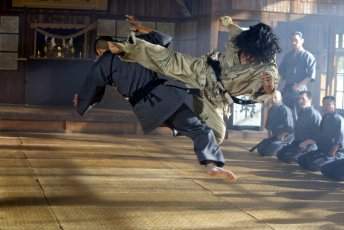 To support Kim's thesis, Choi's life must begin as a pathetic one, one where he must experience traumas, fires from which this masculine phoenix can rise. And Choi is indeed pummeled into place. Played by Yong Dong-geun (Address Unknown, Bet On My Disco), we witness Choi receive several beat downs at the hands of Japanese men. Although somewhat skilled initially through boxing training, Choi wants to improve his fighting skills through martial arts. Along the way, he befriends a fellow ethnic Korean (Jeong Tae-woo) who eventually becomes successful running a pachinko parlor, one of the businesses ethnic Koreans are known for in Japan. He eventually meets another ethnic Korean, this one a circus bodyguard with one hand (played by the prolific action director Jung Doo-hong who has also acted in films such as Champion and Arahan). He agrees to train Choi in martial arts, but from the teachings of the great swordsman Miyamoto Miyashi. Although these relationships may seem to run counter to Kim's thesis, that our hero must resist collective identity, Choi eventually isolates himself off from the rest of the world like the IV-th incarnation of Rocky in the Japanese equivalent of Siberia. After his hermitage, he begins to travel the countryside taking on challengers one by one. The rest of the story is public knowledge so I'm not ethically obligated to withhold the ending, but I will still refrain for those who wish to remain ignorant of the story before they see the film, since such allows those audience members further suspense. But let me add that Yong's portrayal of the obligatory 'final battle' subverts the genre's typical denouement, perhaps in an effort to present an ending even the well-informed audience wasn't expecting.
Although Choi's character resists a collective identity, the film obviously has some ethnonationalist intentions - to celebrate and idolize the success of a man whose fight for self respect is metaphor for a fight for Korean national esteem in the face of Japanese and American colonization. Yang, as quoted by Portuguese critic Luis Canau, has said that "In Japan (Choi is) known as Japanese. I wanted to make very clear that Choi was Korean." Pertinent to the development of this ethnonationalist myth is the fact that Choi is trained in Japanese martial arts. Here we have an ethnic Korean mastering an art/sport/ethics that is particularly tied up with Japanese masculinity. Moreover, Choi's geisha girl, Yoko (Aya Hirayama -- Waterboys), has fallen in love with him because he protected her from the Americans when her Japanese countrymen failed to do so. And finally, we have Yoko eroticizing Choi's national body, the camera's gaze caressing his bruised physique alongside Yoko's hand. Although Yang has said he did not want to falsely portray Choi as someone who resisted Japanese imperialism, which I believe Yang accomplishes, there is still enough ethnonationalist dialogue and direction surrounding Choi's personal quest that I can understand how someone might leave this film mis-associating Choi as one aligned with Anti-Japanese sentiment.
These efforts to re-buttress patriarchal views of masculinity at the expense of the lower classes are endemic in all the world's cinemas. Far be it for me to request fighting words rather than fists of these disenfranchised characters when the colonial powers that be who do the disenfranchising will rarely listen anyway. But such heroic depictions of violence sometimes ignore the reality that such constant battling will more likely end in dismemberment, detainment, or death. At least here we have Choi's subtitled mantra - "I am more afraid of surviving as a cripple, than dying while I am fighting!" By preferring death to dismemberment, he resolves that his only avenue to justice is through the powerful agency of his full physical abilities. The film's claim that "Justice without power is empty, but power without justice is only violence," implies that we will eventually witness justified power, absolving the depictions of previous violence. Whether or not Fighter In The Wind succeeds on this point, I'm still pretty ambivalent about. Putting aside the unproven claim that depictions of violence beget violence, fully aware of the morality plays we can work through when witnessing violent theatre such as this or professional wrestling, I find myself wondering how such romanticizing, rather than demonstrating a need for nations to address oppression, might encourage acceptance of such disenfranchisement as so-called 'character building.'
It is always interesting to see the nuanced variations that emerge with each cinema recycling of the masculine. Choi is very contained in his violence, eventually showing great control of his power rather than raging like a bull. He conveys a sensitivity and passiveness, along with a refusal to transfer injustices placed upon him to his similarly oppressed girlfriend. Still, such films have lost their effect on me, no longer drawing me into the wish fulfillment of fists of fury, (although the bursting choreography by Jeong and Choi is quite visually pleasing). But, obviously, such films are still made for a reason. I guess there is still much to fight about. Or to watch others fight about. (Adam Hartzell)

A petty thief Seok-tae (Kwon Oh-jung, Tube, TV series Damo) betrays a middle-rank thug Yang-yi (Sex is Zero star Im Chang-jung) and runs off with a pocketful of smuggled diamonds. Seok-tae gets stranded in a mini-village named Sisilli (Spelled "The Town Where Time is Lost" in Chinese characters), composed of several households co-habiting a residential compound, led by the lizard-like Byun Hee-bong (My Teacher Mr. Kim, Memories of Murder). No sooner than Seok-tae breathes a sigh of relief, he accidentally strangles himself to death in a bathroom (Are Korean bathrooms really dangerous places or what?). The Sisilli residents, not quite as innocent and warm-hearted as they initially appear, discover a few nuggets of diamond with his body, and are driven insane with greed. However, they barely have time to bury the poor thief before Yang-yi and his idiot gangster cronies descend on Sisilli, determined to locate Seok-tae and his hidden cache of the precious stones. Oh, yes, there is also a "virgin ghost" (Im Eun-gyung) haunting the local orphanage/school, who speaks in Chungcheong Province accent ("You peeeople are baaaad..."). So what's not to like about a retreat in the countryside, eh?
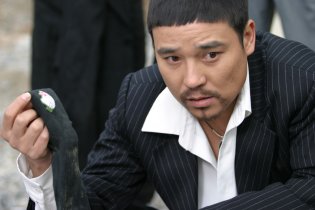 To Catch a Virgin Ghost (a terrible English title) begins very promisingly, as we are introduced to the Sisilli residents, a sort of crassly middle-class, consumerist Korean version of the Texas Chainsaw Massacre family. The undertones of menace and macabre are nicely evoked amidst the rhythmic interchange of the dialogue among Kwon, Byun and other (terrific) actors portraying the village residents. This part of the film is simply great and builds up expectations for further zaniness, which, alas, fails to materialize. Director Shin Jung-won (previously an art director for Sex is Zero), working with a trifle messy but inventive screenplay by Lee Chang-shi and Hwang In-ho, steers the latter part of the film toward an inter-dimensional (?) romance between the living gangster Im Chang-jung and the dead ghost Im Eun-gyung. Im certainly proves a trouper (she keeps the opaque white-on-white contact lenses on throughout the movie, except in brief flashbacks) and is actually quite charming as a ghost too gentle and considerate to be really scary. The film is so energetic that you tend not to notice some clumsy set-ups and hurried executions. I could see the seams breaking apart, for instance, in the climactic zombie battle involving multiple possessions and an impending evisceration of Yang-yi, but I was having so much fun with the very audacity of it to let the clunky parts bother me.
The big problem with Virgin Ghost in my opinion is that as soon as the "funny" gangsters enter the picture, cursing, shouting and hurling brain-damagingly unfunny jokes at one another, the film's creativity meter drops to the bottom. Even though the filmmakers obviously intend to make us root for Yang-yi, whom, we are laboriously reminded, is really a swell guy (he even gives his much-older underling a permission not to call him "Big Brother." Wow, what an egalitarian mindset!), to kick the collective behinds of the dastardly Sisilli residents, I had the opposite reaction by the film's (undeniably entertaining) climax. I was in fact rooting for Uncle Byun and his folks to dismember and decapitate all gangsters, including Yang-yi, make ground-round patties out of them, and have a big success running a chain of fast-food stores peddling "fresh gangster meat."
Virgin Ghost was relatively well received by critics and proved a hit (in 2004's lackluster summer season) with the Korean domestic viewers, scoring nearly 2 million tickets sold nationwide. They no doubt responded well to Im Chang-jung's comic performance as well as the film's crafty mixture of the quirky and the familiar. It is a far less affecting film than, say, R-Point or Spider Forest, but is heads and shoulders above other generic horror or comedy films churned out with a nauseating regularity by the Korean film industry these days. A piece of remonstrance to the Korean filmmakers: if you must put jopok characters in a horror film (even comedic ones like Virgin Ghost), make sure you kill them all off in the first ten minutes. Please. (Kyu Hyun Kim)

War and horror as cinematic genres can make compelling partners. Many war films-- Apocalypse Now (1979) comes to mind-- have in fact drawn upon conventions and tropes of the horror genre to depict the cruelty and madness induced by the dehumanizing conditions of an armed conflict. Conversely, supernaturally inclined horror films have sometimes mined the battlefields to explore their character's psychology, especially guilt and paranoia, in such well-known examples as Jacob's Ladder (1990).
R-Point, the directorial debut of the screenwriter Kong Su-chang (Tell Me Something [1999], Ring Virus [1999] and another Viet Nam-themed film White Badge [1992]), combines all these elements into a potent mix. The film is an unabashedly political commentary on the suppressed history of Korean involvement in global armed conflicts, including the current entanglement in Iraq. It is also a very good conventional horror film. There is no shortage of the things that go bump in the night, even if many of the techniques employed are not so inventive (the least effective among them is the ghost's POV shots, completely unnecessary and diminishing the intensity of some scenes). On the other hand, I liked the idea of radios functioning as a sort of psychic machine that amplifies anxiety and fear among the troops. The location shooting in Kampuchea (including inside the eerie, abandoned hotel originally built by the French) is highly effective and suffuses the film with a genuine sense of foreboding.
 The film's greatest asset is its excellent cast, led by Gam Woo-sung (Spider Forest), using his intellectual and clean-cut demeanor to portray a shell-shocked officer drowning in cynicism, and Son Byung-ho (Mokpo, Gangster's Paradise) as a tightly reigned-in, pressure-cooker sergeant whose violent impulses are just waiting to be unleashed. The supporting roles are designed to present a cross-section of rural and lower-class Korean males some thirty-odd years ago, but the actors all rise above the stereotypes. It is a testament to their acting (and good writing) that we end up caring about these characters and do not feel the urge to play the game of "Who's gonna get it first?" Kim Byung-chul as Private Cho initially appears to be set up for being either the requisite "expert" on supernatural matters or a comic relief, with his owl eyes and comically "square" line delivery, but he presents a full-rounded character. Oh Tae-gyung (the younger Dae-su from Oldboy) and Park Won-sang (A Smile, etc.) make an odd couple, playing a take-no-crap-from-anybody teenage ruffian and a happily married but easily tempted mess-worker, respectively, with somewhat predictable character arcs, but they expertly play off each other, culminating in one of the most haunting death scenes in recent memory. The powerful climax of the film is almost entirely dependent on the acting of the cast, with the minimum of SFX razzle-dazzle, as the characters completely lose their bearings and are overwhelmed by paranoia. They pull it off beautifully: the sequence successfully translates the frisson and immediacy of a great theater act onto the screen.
I must point out that R-Point, with all of its subtle and balanced characterizations (American soldiers are not depicted as gum-chewing macho hunks ready to hunt down "Charlies," for one), is not that removed from a liberal America-centered take on the Viet Nam conflict, such as Casualties of War (1989) and Platoon (1986). What is invariably missing in these films is a Vietnamese perspective on the "foreign invaders." The Vietnamese native figure is almost always feminized, as a victim of rape and male aggression, even if R-Point makes it clear that she takes an active role in retaliation against the foreign army.
Still, young Koreans living today could certainly use a reminder that Korean soldiers were once the hated "invaders" and no, you cannot blame Americans or Japanese for what they have done to the Vietnamese people. R-Point is highly recommended to those who like intelligent and thoughtful thrillers that have more on their minds than just giving you goose bumps. (Kyu Hyun Kim)

Melodramas tend to be hit or miss with Korean audiences. Conventionally structured stories are often ignored (Au Revoir UFO, The Garden of Heaven), but films that approach their topic from an unusual angle, or contain a modern sensibility, can sometimes break out to become successful box office hits (A Moment to Remember, The Way Home).
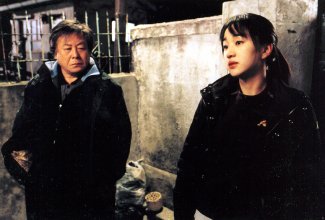 Before its release, Lee Jeong-cheol's debut feature A Family looked like a strong candidate for the former category. Among its cast, the only recognizable star was lead actress Soo Ae, who had up until then only appeared on TV. The story itself also didn't seem likely to appeal to young viewers -- with no romantic angle, it focused on a single father and his troubled relationship with his daughter, who had gotten mixed up in a street gang. Released in early September -- a quiet period before the major Chuseok holiday -- many expected it to fade into obscurity.
Nonetheless, A Family proved to hold something special for its audience, and became perhaps the only genuine word-of-mouth hit of 2004. Viewers were particularly touched by the assured acting of Soo and veteran actor Joo Hyun. In place of flashy visuals or a complex narrative, director Lee put the performances of his leads at the center of the film, with all else serving only to complement their words and actions. A bit old-fashioned, some might say... but the result speaks for itself.
For Joo Hyun, best known for playing supporting roles in films like Saving My Hubby, A Family was a high-profile opportunity to showcase his considerable talent. The father who hides his love and concern beneath a gruff exterior is such a common role that it must have been hard to breathe life into the character. Yet in his accomplished handling of small details and the film's quieter moments, Joo succeeds in making the father a real person instead of a stereotype. Also notable is child actor Park Ji-bin, who would go on to take a lead role in the 2005 film Little Brother.
Soo Ae, meanwhile, is the film's major discovery. Often compared to Jeong Yun-hee, a legendary actress from the late 70s and early 80s, the 25-year old Soo is memorable and convincing as a kid fresh out of jail, struggling to put her life in order. Her character is tough and unafraid, while also being fiercely protective of her brother and father -- the type of role that young actresses are seldom given. After the success of A Family Soo was quickly cast into her second film, and in the coming years she is likely to become a familiar sight to fans of Korean cinema. (Darcy Paquet)

Kang Min (Gam Woo-sung, Marriage is a Crazy Thing, R-Point), a producer at a TV broadcasting station, drops in an isolated cabin deep in a forest. There, he discovers the body of a middle-aged man hacked to pieces, and his girlfriend Su-yeong (Kang Kyung-heon), mortally wounded. Pursuing a shadow appearing to be the perpetrator, he is counter-attacked by the latter and drags himself down to a road, only to be smashed flat like a bug by a speeding SUV. Barely surviving brain surgery, Kang finds himself a prime suspect in the double murder case. And yet, he cannot shake the feeling that there are some strange gaps in his memory regarding the killer's identity. Aiding Kang in his tormented quest to figure out the truth are the owner of a beaten-down photographic studio near the forest, Su-in (Suh Jung, Peppermint Candy, The Isle), with the face of his dead wife, Eun-ah (also played by Suh Jung); and Detective Choe (Jang Hyeon-seong, also in Song Il-gon's latest film Git) assigned to the case.
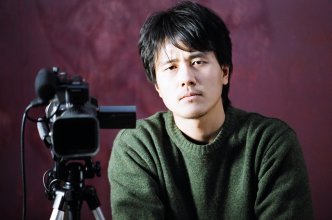 It is difficult to characterize Spider Forest in a succinct marketing formula, which perhaps explains its failure at the domestic box-office. More likely, the viewers were disappointed at the fact that the film is not a clever brain-teaser like, say, Memento (1996) or Identity (2003), although it does wrap up its convoluted mystery into a logical resolution at the end, at least in my opinion. The "answer" makes total emotional sense, even if some of the puzzle pieces are left for the viewers to fill in on their own. So take it as a fair warning from me that the movie is not best appreciated as a tightly constructed murder-mystery. Nor is it by any stretch of imagination a horror film (unless you want to call David Cronenberg's Spider [2003] a horror film as well... another excellent work of art that explores a similar theme from a very different angle).
Spider Forest is, beneath its surface dressing as a vaguely supernatural mystery-thriller, an exploration of one man's profound grief and inability to come to terms with his failings in life. In this sense, and also in tone and aesthetic sensibility, it is highly reminiscent of the works of Eastern European and Russian masters, especially Andrei Tarkovsky and Krysztof Kieslowski.
The tropes Spider Forest makes use of are thoroughly "Western" but not in the superficial sense of the accoutrement for sophistication and philosophizing. Intricate as they are, they are adeptly harnessed for an intellectually and aesthetically coherent presentation of the film's spiritual theme. For instance, I was startled to realize that Eun-ah's little mime performance for her husband's amusement, using an invisible apple, is a retelling of the Serpent's seduction of Adam and Eve: later, when the Chief Producer Choe (Cho Seong-ha) is brutally semi-raping a character, he is seen loudly crunching on apples, squawking "Life is a war... War war." At another point, a petal from white flowers, dried like dead skin, leaves a heart-shaped marking on a glass table amidst a layer of dust. An unnaturally green blackboard in an elementary school classroom recalls the green scarf worn by Su-in, which in turn anchors her character in the greenery of the forest. The spiders, the guardians of the forest, with the cobwebs they spin around the dead bodies, represent the memory the characters want to keep locked in the dark recesses of their minds. And finally the climactic realization of the metaphor "light at the end of the tunnel" is made doubly ironic due to the nature of the location the "end of the tunnel" leads to.
Director Song Il-gon, as he did in his previous film Flower Island (2001), does a marvelous job with the cast he has assembled. Gam Woo-sung, still looking like a poker-faced university professor with a Ph.D. in French literature, nonetheless articulates with superb sense of control the subtly differentiated shades of Kang Min's character. Suh Jung, on the other hand, is going to stun anyone who remembers her only by her turn in Kim Ki-duk's The Isle (2000). Here, her fierce glare has been tempered into the gentle gazes of a woman content and happy in love, and conversely, grieving over the suffering of a loved one. She is particularly brilliant in the role of Eun-ah, who must project girlish charm without compromising her depth of soul in a relatively short span of screen time. The eclectic but excellent supporting cast includes Pak Won-sang (A Smile, R-Point) as Kang's disabled producer colleague, Son Byung-ho as the surgeon who operates on Kang (Son, perennially typecast as violent or slimy villains, is allowed to essay gentle and sensitive characters in Song's films. When are we ever going to have a Korean movie with Son Byung-ho in the lead role?), and Yun Ju-sang (Arahan, President's Barber) as the elementary schoolteacher.
Spider Forest is a (psychoanalytic) fairy tale for adults, dark and painful but also acutely compassionate. Its parable-like structure is echoed in the stories the two characters played by Suh Jung perform and tell to the protagonist, sorrowful and beautiful, underscored with the feelings of loss and irrecoverability of past happiness. Having gone through an experience of loss akin to its protagonist's, I have to admit that I was deeply affected by the film. It is so far the most moving Korean film I have seen from 2004. (Kyu Hyun Kim)

With all the talk of the greatness of such actors as Choi Min-shik, Song Kang-ho, and Sol Kyung-gu, one can be concerned that actors who aren't as great but definitely know their craft might get lost. Cha Seung-wan (Kick The Moon, Jailbreakers) is just such an actor. I was first introduced to Cha's talents when Q urged me to check out My Teacher, Mr. Kim. Just as Cha is not a brilliant actor, this is not a brilliant film, just a good one. But Cha's ability to present an unlikable character's evolution to likeability sparked my interest in his work. And it is Cha's presence in the entertaining Ghost House that saves the film at the beginning when director Kim Sang-jin's pacing is less precisely tuned than the wonderful second half.
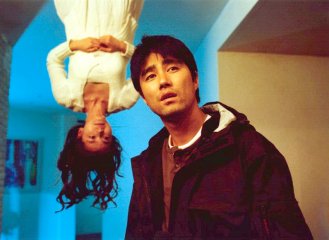 Cha plays Park Pil-gi, a man who has worked hard in order to buy his first home. And this will indeed be his first home, for we are provided flashbacks of his youth where his single father treks from rental to rental throughout Pil-gi's youth. It is on one of these moves that Pil-gi's father suffers a heart attack and dies. A lot is tied up in Pil-gi's purchase of a home beyond just pride in ownership. Unfortunately, the home he has purchased is haunted. The first half of Ghost House consists of purposely comic horrors of the ghost wanting Pil-gi to leave her home. (You know from the posters advertising the film that the ghost is a she (TV star Jang Seo-hee - The Crescent Moon), so I didn't give away anything.) None of the effects are intended to scare since this is, first and foremost, a comedy. This is Kim Sang-jin directing this, people. The most successful of recent comedy directors in South Korea, his success continues here with Ghost House being the fourth highest grossing Korean film of 2004. As if citing his own history, Kim cleverly appropriates Attack the Gas Station, the first of his successful comedies, along with the horrorifying-ly successful Ringu for the first sign of the house being haunted.
Although Pil-gi is freaked out enough to sell this home, he is worried about cutting too great a loss. And the whole town knows the house is haunted which scares away potential buyers. Pil-gi's despondency regarding all of this eventually results in his befriending his boss at the shipyard (Jang Hang-seon - Tell Me Something, The Foul King), a man whom we learn has a sixth sense. That is, he can see dead people. Eventually Pil-gi, after lightening electrocution, develops this skill as well, allowing him to see the uninvited guest who thinks Pil-gi is the uninvited guest, and it is here that the film gets good, such as a nice scene of mistaken infidelity with Pil-gi's girlfriend. (There's more to discover in this film that I have not told you, such as why the ghost still lingers at the house, and another plot twist emerges that will resolve with an Attack the Demolition Site fight scene, so don't be concerned that I've told you too much.)
Kim Sang-jin shows that he still has what it takes, this being his fourth straight successful comedy. He has relied on Cha for three of these successes, and as much as I'd love to see more of Cha, perhaps Kim should branch out some. (Like, how 'bout giving my favorite comedian Kwon Hae-hyo a vehicle?) Although not a film that had me guffawing violently, (a good thing since I watched this film while recovering from lower back surgery), the film did have me going beyond a simple smile of appreciation to laughing out loud.
There are faults to the film. Most particularly a scene that seriously lessens the theatrical impact. I am speaking of Pil-gi's three attempts to exorcise the home, with indigenous shaman, Catholic priest, and Buddhist monk. Kim chooses to set these up as three separate frames on the screen, the left half of the screen taken up entirely by the one he intends us to focus on, and the right half of the screen split horizontally by the other two. Each exorcism gets some time on the left side. Although this technique may be explained partly as an effort to be expeditious with the narration, since showing all three would have added even more minutes to this film that tracks at just barely below 2 hours, my initial watching of this sequence was frustrating, because I appeared to be missing funny moments while attending to the exorcism featured on the left half. (I found myself particularly drawn to the shaman scenes since they had Pil-gi humorously bouncing along in cymbal time with the shaman.) I assume others watching this in a theatre would experience the same frustration and confusion. DVD technology allows us to go back and watch each exorcism completely, but rewinding lessens the impact of the totality of the film. Kim could have edited down some other scenes to allow more space for the full effect of each exorcism's antics.
(I must note that it appears that an animal was harmed in the making of this film, a chicken. I would like to assume that the chicken's remains were prepared for a meal later, but I don't know. Although this act is ethically critiqued immediately and yet again later in the film, a critique that is Korean-specific in that chicken blood is supposed to ward off spirits but here instead it creates vengeful ones, with all the CGI special effects throughout this film, you wonder why they didn't also utilize CGI for the effect of a chicken getting its head cut off rather than going for the documentary effect. And this documentary effect is the only time such a style is utilized in the film, making it inconsistent. Regardless of the cultural differences here, as Darcy has noted in his review of Blood Rain, which also stars Cha, such acts of animal slaughter will sour the reception of such films in certain other areas of the world, particularly the US, if directors intend to seek distribution in these areas.)
The film is not a complete success, but I was definitely entertained. It appears that Kim's audience isn't asking for greatness, they are just asking for consistency of comedic effect. And so far, Kim's house of comedy has nothing to be scared of. (Adam Hartzell)

Outside of the boxing film, baseball appears to be the sport most commonly mined for filmic narratives. Perhaps this has something to do with the slow pace of the game and the multiple opportunities for character development in player looks and placements. One can do a lot with a baseball game to show characters struggling with their egos, their demons, their circumstances, and those of others. Perhaps because the baseball diamond is a setting often used, it seems we have come to expect certain tropes from baseball films, that is, the 3-2 count, bases-loaded, bottom of the ninth scenario. Although Kim Jong-hyun's Mr. Gam's Victory still calls up some of those tropes, the film balks at others enough to leave me feeling I had a good time at the cinematic ballpark.
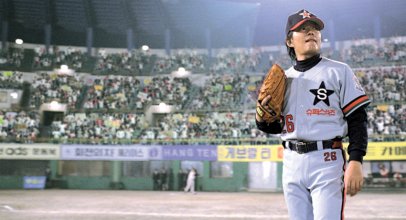 Roughly based on a real-life baseball player for the Sammi Superstars, Gam Sa-yong, this romantic comedy within the sports genre form is primarily a vehicle for actor Lee Beom-soo. I wasn't all that impressed w/ Lee in Wet Dreams, but after Singles, Oh! Brothers, and now this film, let it be officially noted that Lee has grown on me. The film begins with Gam before he joins the Sammi Superstars. Gam lives with his mother, older brother, and younger sister while working at the Sammi factory. He also plays on the local company team where his south-paw pitching is quite competitive. We are quickly introduced to Gam's dream of becoming a professional pitcher and when pitching tryouts for the Sammi-sponsored, professional team are announced, we expect Gam to jump at the chance. However, Gam presents ambivalence regarding whether or not to participate. This hesitancy is partly fueled by Gam's insecurity about his abilities and his mother's expectations that he generate income for the family since Gam's older brother can't be trusted due to his affinity to gamble and drink money away. Gam does eventually make the squad and the film takes on a Bad-News-Bears-esque tone since the Sammi Superstars are anything but super or stars. The film reaches its climax in a genre-required 'big' game, although not the typical big game we have come to expect.
As I said in the first paragraph, director/screenwriter Kim does rely on certain sports film genre tropes, including the obligatory love interest, but, to his credit, he refuses to fully Naturalize the original story here. The most interesting twist to this story often told is Kim's inclusion of a parallel story about Gam's co-worker pursuing her acting dreams (played by Oh Su-min). In this way, we aren't left with just the love interest or matriarch as the only major female portrayals, women left to live vicariously through the male protagonist. This parallel allows for us to see different gendered trajectories towards one's goal, showing a female character with her own separate agency. Although we don't share witness to her struggles, we can infer much about the obstacles she had to face through the brief references to points in her journey throughout the film.
Like the boxing movie Champion, Mr. Gam's Victory takes place amongst '80s signifiers, this time including Twisted Sisters's "We're Not Gonna Take It" as Gam's personal soundtrack. Also like Champion, we have a shot from above our main character as he contemplates his dreams in bed, looking down onto our hero lying on the floor as he propels his hand forward at us. (In Gam's case, with a baseball rather than boxer Kim Deuk-gu's punching-bagging of a light fixture.) And it is these shots of the individual hopes of our character that provide one of the wonderful counterpoints of this film.
In his contribution to the series of essays Baseball and Philosophy: Thinking Outside the Batter's Box, Michael Brannigan questions the very idea of "Japanese" baseball and how commentators have dichotomized it as different from "American" baseball. Although differences exist between how the game is played, (one difference from American baseball that Korean baseball shares with Japanese baseball is the ability to end a game in a tie, although this will soon be changed in Korean baseball), Brannigan calls for "exercising prudence when generalizing" cultural differences upon the practice of a sport. As an example, cultural observers may be too quick to overly state the absence of an 'I' in the Japanese baseball "team," that is, the preferencing of the group over the individual. Brannigan discusses the less-noted individual ethos of the greatest player to ever pick up a bat in the Japanese league, Sadaharu Oh, to demonstrate how what an observer expects to see may erroneously intrude upon what is actually there. (Sadaharu Oh also challenges assumptions about homogeneous Japan since he is part Chinese.) Korean baseball risks similar over-generalization since this group-over-the-individual ethic is often over-generalized to all of Asia. It's there, but it may not be there as much as cultural observers claim. Just as group-think is more a part of Western culture than is often admitted. Mr. Gam's Victory exists as a counter to full-on group priority in Korean society by allowing us to be spectators of Gam's personal dreams that are not reliant on performing well for the group. Yes, he wants to be held in esteem by others, he wants to make his moms proud, but this goal is very much his goal, not his team's, not his country's.
Mr Gam's Victory succeeds enough to carry through to the final section of the film, where it is at its best. Although not one of the greatest sports stories ever told, it was never meant to be. Just merely an entertaining one, like a pleasant day at the ballpark when the weather's warm, the sky is clear, your garlic fries aren't cold, and nobody's drink was spilled on you as you passed it from the beer man to the seat further down the aisle. (Adam Hartzell)

Of the many accomplishments achieved by Park Chan-wook's Oldboy, the one I'm most pleased to see is the number of international critics beginning to recognize one of South Korea's greatest contemporary actors, Choi Min-shik. Although Choi appears to be continuing on the fight club circuit with Ryu Seung-wan's upcoming boxing film Crying Fist, what are we to make of Choi's decision to step off the alpha-male train for a moment and become a struggling trumpet and saxophone player who sucks up his pride and takes a job in one of the more zeta-male of professions, as a wind ensemble teacher for a middle school, in Ryu Jang-ha's Springtime? Well, what we can make of it is that such a vehicle allows us to see how versatile, thus exceptional, Choi's thespian skills truly are.
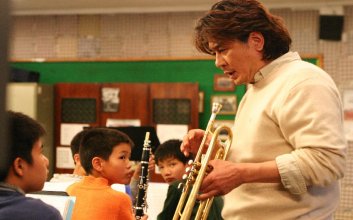 Choi plays Lee Hyeon-woo, a man of initial bitter principle. He wishes not to 'taint' his musicianship through performing at cheesy nightclubs; competing at auditions; playing for money, fame, or women; or humiliating himself through teaching, especially kids. With such limitations placed on his craft, 40-something Lee finds himself still single and living with his mother. Taking stock in his life and discovering the irascible curmudgeon he risks becoming, Lee utilizes the engagement of his ambivalent love, Yeon-hee (Kim Ho-jung -- Nabi, Barking Dogs Never Bite), to another man and yet another fight with his mother as an opportunity to finally move out, eventually taking the previously mentioned, and previously scorned, position in a remote mining town. In fact, he will end up contradicting every "ethical" stand his earlier stubborn self made. As a middle-school band leader in this town of slightly beaten, but never down, individuals, Lee does not exhibit the drastic change one would expect in a Hollywood opus, but experiences a slow, well-paced discovery of self, the kind that leads to a more lasting change.
Choi delivers a well-rounded performance, but not through the fiery emotion we are familiar with in Oldboy, but for his subtlety in affect that gradually grows on this viewer. Think Failan without the brief steps into slightly manic melodrama. Director Ryu and his co-screenwriters (Lee Eun-kyeong and Yun Jae-geun) have presented an excellent vehicle for Choi's tempered skills rather than his visceral virtuosity. The supporting cast, particularly the wonderful Yun Yeo-jung (A Good Lawyer's Wife, Insect Woman) who plays his mother, all work well off each other and slowly add to the warm impact of this lovely story with multiple endearing scenes, such as Lee initiating a New Year's greeting to a student's hal-meo-ni (grandmother).
Mind you, it's not perfect. One scene that disappoints is Lee's first intervention with a student's father who won't let his child play in the band. Lee's intervention asking the father to respect his son's need to dream is unsuccessful and so is this scene due to the score's intrusion lessening the impact. The problem with this scene is even more noticeable in a rhyming scene that follows where Lee asks his mother about her dreams, dreams he assumes she deferred. Lee's mother ends up teaching her son that dreams are not necessarily tossed aside later in life, but can be refashioned based on outside circumstances. Rather than bring the score in to intrude this scene with overly melodramatic tactics, the score comes in after the dialogue and scene are completed, resulting in a coda of the emotion rather than ruining the emotion as in the former scene.
The intrusion of the score in the earlier scene is ironic since this film makes the case that what is most important about music is not the recognition or riches that can result from performing, but the harmony and melody music metaphors in our own lives. Dissonance is a sign to reclaim the harmony that is there if we'd only bother to listen beyond the cacophony of sounds that surround us, as Lee demonstrates when he hears a trumpet score he wrote being played behind popping and whizzing fireworks. I didn't know when the film would take me to the renewal it hinted at in the title, but Springtime eventually orchestrated a well-composed film that, although nowhere near a masterpiece, is one of those films that stays with you like a song you find yourself whistling absent-mindedly at work. (Adam Hartzell)

Since his debut in 1996, Kim Ki-duk has released at least one film a year, (with 1999 being the exception), and often releasing two. With The Bow ready to drop Spring 2005, it appears Kim will keep up this pace. Although not even close to the output of Korean directors from back in the day, (Im Kwon-taek averaged 5 films a year in his first 10 years), considering the above-average production quality of his films, this high output is impressive. Yet although I give Kim props for his obvious work ethic and efficiency, this same speed intrudes upon the narrative of his most recent effort, 3-Iron, lessening the impact this film could have otherwise had on me.
Despite what Tony Rayns has claimed in the November/December 2004 issue of Film Comment, Kim does not "shamelessly plagiarize" one of my favorite films, Tsai Ming-liang's Vive l'amour. Yes, our male protagonist (Jae Hee) places flyers on house doors throughout town, for a restaurant rather than a crematorium, and he does take secret, temporary ownership of a residence. But really, that's it. Everyone gets naked in bathrooms at some point in their lives. If anything, Tsai's love of film that is an ironic take on a love of life is merely a tiny starting off point for Kim. Here our protagonist breaks into homes by picking locks, breaking into several homes, not just one. While in the homes, our male protagonist uses the facilities to shower, wash his clothes, eat, sleep, and violate the intimacies of the household. As if meant as payment to the owners, our protagonist also fixes random items in the house and mists their plants, allowing his presence to be spectrally felt by the legitimate proprietors when they return. While in one of these homes, he stumbles upon an abused wife (Lee Seung-yeon - Piano Man) who chooses to float with our male protagonist as our female protagonist within the film. Characteristically for Kim, and like Tsai and a whole bunch of other directors, both protagonists are ghostly silent through most of the film, which has the side commercial benefit of making the film easily mobile across international borders.
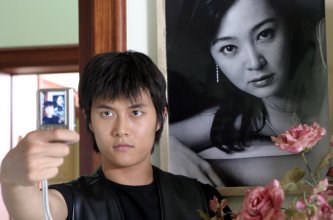 In Jung Seong-il's interview of Kim for Screening The Past, Kim, in reference to his film Bad Guy, commented on his preference for "...filming my characters with straight angles as though they were posing for a portrait." Such a preference is vividly on display in 3-Iron, since our male protagonist takes meta-pictures, a picture of him in front of a picture of the official residents of each home, while invading these homes. Kim the artist emerges through these wonderful images. The shot of all shots is a shot of shots where a character is treated to Kim's perpetual cycle of violence. Just look at the wonderful, house-of-mirrors colonnade underneath the bridge as the pummeling begins and continues. The perspective recalls the meshed architecture earlier in the film that allows for the perpetrator to aim squarely. 3-Iron continues Kim's tradition of violent images tinged with disturbing beauty, here the beauty provided by cinematographer Jang Seong-bak.
But 3-Iron leaves me unsatisfied for two reasons. One reason for the limp impact is the acting, which is occasionally not executed well. The female protagonist's husband and the prison guard come off forced and awkward. Lee Seung-yeon's and Jae Hee's performances falter at times. Still, when Jae later practically reverse-anthropomorphizes, those eyes rolled back like a gecko, those preying-mantis-y arm movements, Hee's physicality is strikingly well-performed.
These moments of faulty execution might be better explained by the main reason for my dissatisfaction that I mentioned before - the pace. If anything underscores how 3-Iron is not Vive l'amour, it is Kim's quicker rhythm. Kim cuts quickly from one item to the next. The invasions of the homes are a collage of images rather than a meditative watching of events. I don't require Kim to be Tsai, so such directorial choice is fine. However, this quicker editing seems to be inconsistent with Kim's themes. One of the cultural specifics Kim is working with here is that of the ghost beliefs held by a significant number of Koreans. Although not a literal believer myself, I am a metaphorical believer in "ghosts." That is, ghosts as stand-ins for hidden and denied histories that constantly invade our Presents. Part of what Kim's unconventional ghost tale appears to address is how the disenfranchised struggle like ghosts in order to maneuver around the powerful so that their lives are still fulfilling and, ironically, still human. Kim also had me thinking of those within our homes whom we ignore, the people who built the shelter, who made the stuff we bring in to claim as our own, people whose presence we refuse to acknowledge yet still can't help but feel resonating around us. Each of these themes would have been more effectively explored with long takes that would have allowed this 'Other' energy to seep in more fully, more lastingly. Instead, as if tired of waiting for a cycle of four seasons, I feel as if Kim rushed to get through this film so he could bow to his next project.
Otherwise, those who appreciate Kim Ki-duk's films will find much to mull around here. Violence lurks throughout, surprisingly erupting or clearly signaling upcoming destruction. Besides the violence/love dichotomy, Kim further develops thoughts on home/wandering. One can even see an interesting shot at Corporatist powers-that-be in the use of golf as a weapon. Still, I agree with Rayns' point underneath his condescension -- a condescension to which I can be just as vulnerable in my own private voice; however, I have learned to try to rein this in for my public written voice so as not to risk making unsupportable claims -- that Kim's critique of bourgeois hypocrisies are presented through a similarly hypocritical "outlaw sensibility." Although Kim's 3-Iron desires to imprint a strange sense of presence within absence, I still have yet to turn around and find Kim's spectacle dancing in my personal space. (Adam Hartzell)

In Korea, perhaps more so than in any other country, high technology is all about linking up people. Koreans are less into gadgets per se, than into new and innovative ways to communicate with friends, draw crowds or meet new people. This may help to explain why some technologies have taken off with a vengeance (mobile phones, broadband internet), while others have been adopted at a much slower rate (DVD, satellite TV).
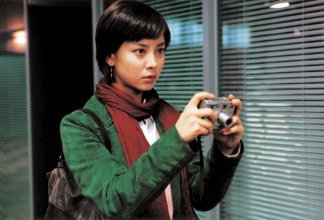 Chang Yoon-hyun's Some is a thriller, a mystery, and a hesitant love story all in one, but apart from all these things, it's a snapshot of a populace stitched together by technology. The film displays an endless fascination for electronic devices -- computers, CCTV cameras, mobile phones, digital cameras, MP3 players, radios, police surveillance monitors, even light sensors --and the manner in which these devices bring people into contact. Ultimately we get a sense of Seoul being blanketed by technology. Its residents, in order to function in society, must tap into this invisible, all-enveloping field.
A brief exchange from the original screenplay that didn't make it into the final film -- perhaps because it stated the obvious? -- reinforces this point. Our hero Sung-joo, a young detective trying to uncover the leaders behind a major drug scam, boasts that catching criminals is "99% intuition". Yu-jin, a traffic reporter who has been drawn into this investigation seemingly at random, watches Sung-joo operate his police GPS surveillance system and then mumbles to herself, "Intuition? It's technology."
Yet Some, nothing if not ambitious, also sets its sights beyond this realm of physical objects and electromagnetic waves. The plot is structured around two mysteries, the first being the abovementioned missing stash of drugs, which has implicated Sung-joo's former partner. The second mystery is more abstract, centering around a series of premonitions seen by Yu-jin. From the first time she sets her eyes on Sung-joo, she feels like she's met him. As time passes, it becomes clear that, for reasons she can't fathom, she has a strange insight about what is about to happen to him over the next 24 hours.
As a viewer watching this film, these mysteries give you the sense that (a) I am being watched, everywhere; (b) I am linked with everyone else in this city; and (c) fate dictates the future, and I must struggle to break free of it. Some's greatest achievement is the grey-tinged sense of anxiety that emerges out of these sobering realizations.
If Some had been able to deliver all that was promised by its soaring ambitions, it would have been an incredible feature. As it is, it's an exciting and intriguing work, but the ending displays either a lack of confidence in the filmmaker's vision, or a last-ditch effort to make the film more commercially viable (probably achieving the opposite effect). Perhaps what was needed was an ending reminiscent of Chang's previous film Tell Me Something (1999), which may not have held water in a logical sense, but which brought the work to a close with a sense of shock, dread, and an ultra-cool song throbbing in the background. Despite an A+ soundtrack up to its final scene, Some ends with an ear-grating, chirpy tune that tries to erase the somber mood that pervaded the film. The singer seemed to be telling me to hurry up and leave the theater, like the cleaning women who sweep under your feet and glare at you as the credits roll.
Despite these reservations, it's a mystery to me why this film performed so horribly at the box-office. I accept that TV star Goh Soo and newcomer Song Ji-hyo (Wishing Stairs) don't have the star presence of Shim Eun-ha, Han Suk-kyu, or Jeon Do-yeon, who graced Chang's previous movies. Perhaps poor marketing was to blame, because Some didn't face much competition at the box office, yet few viewers bothered to check it out. The crowd I watched it with seemed quite engaged, and word of mouth was generally positive. In the end, Some remains a fascinating, nuanced feature which lost buckets of money, and which is well worth remembering. (Darcy Paquet)

Truth in advertising, there is a moment to remember in A Moment To Remember. Unfortunately, this moment the production company Sidus Pictures wants us to remember has nothing to do with the rest of the film John H. Lee directed. No, the memorable moment is the scene of love at first sight facilitated through the matchmaker skills of the primary brand of a US-based, global, beverage company. Since this film wants to be more of a philosophical exploration about memory than it is, it is interesting that the matchmaking comes to fruition thanks to Su-jin (Son Ye-jin - Lover's Concerto, The Classic) remembering she'd forgotten not the more important item for her livelihood, her wallet, but the most important thing for this commercial, the pop can. (I'm from the Midwest, humor me.) This commercial that begins the film is well-orchestrated and could easily be cut from the film and placed between your favorite Korean TV drama and you'd fully get the pitch of the product. But it could equally be cut out from this film without losing much. It would have made just as much sense plot-wise for Su-jin to first meet Chul-soo (Jung Woo-sung - Motel Cactus, Musa) when her father sent him over to fix the bind in which Su-jin's manager found himself. Dropping the ad would have provided more time for the over-committed plot points that Lee jumps from all willy-nilly throughout this film, and this would also eliminate the predictable nature of the ending.
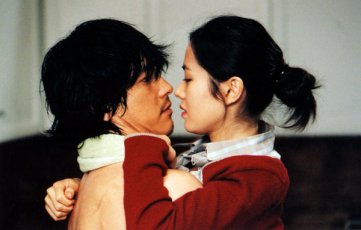 The film begins with Su-jin waiting at a train station for her never-to-arrive lover. We will learn through the gossip mill at her new job that she was having an affair with a married man which resulted in the dissolution of that marriage. This part of the plot is dropped, allowing Su-jin to easily make friends amongst the gossip-mongers of her office without any explanation regarding this allegiance shift, to be brought back later to escalate the melodramatics in the film. (Sadly, this plot point is wasted in the film because it could have been more fully fleshed out to provide an interesting story if many of the other side plots, such as the poorly structured story around Chul-soo's mother, were dropped.) Su-jin's new love interest is the man with the can on which the camera pans so lovingly in the ad that opens the film. He turns out to be a carpenter who works for her father's construction company. We then proceed through a courtship that eventually leads to marriage, but only after a brief tangential moment of a drastic shift in temperament of her otherwise surprisingly progressive father. Then all hell breaks loose as Su-jin's health meets a sundry of other melodramatic cliches.
With all its faults, there are moments of this film that are quite funny. Although most of these moments aren't intended to be humorous, let's begin with one that is and works well. This scene involves Su-jin having her purse snatched and Chul-soo coming to her rescue. This successful rescue results in much destruction to Chul-soo's jeep which, in offering Su-jin a ride home, allows for some nice physical humor involving head gear. However, it's the slapdash of melodrama standby's that presents most of the humor, which is the film's primary problem. The histrionics and bizarre turns of the plot make for quite an unintentional comedy. Although I felt bad laughing at obviously score-coded "serious" moments, I couldn't help it because it was just so ridiculous. The scene at the prison with Chul-soo's mother is a narrative jump as crazy as Chul-soo's mother is purported to be and it bewildered enough people in the audience when I saw this film that I don't feel alone in my interpretation. Unfortunately, the film utilizes a real life disease to carry its disjointed plot along, which could risk offending some who have direct experience with this disease through friends and relatives, making me feel even worse about my gut guffawing if such individuals were in the theater watching this along with my laughing self.
Just as the film itself does, let's return to the product placement. My beef with product placement is when it disrupts, when it virulently sticks out from the narrative. The car and soju product placement in A Moment To Remember do not bother me because they are brief (thus forgettable) and do not force an entry into the narrative as do the pop can and the convenient store chain. Much better films are guilty of disruptive product placement as well. When the brand name shoes are imposed upon us in Miranda July's Me And You And Everyone We Know, the bright blue-ness of them grabs our attention away from all the other compelling aspects of July's debut up until this moment. The fact that people don't tend to go to department stores to buy this brand of shoes exacerbates the dissonating, awkward effect of this ill-conceived ad. The product distracts from an otherwise wonderful film. Lee has the opposite problem, sadly. That is, his direction of the two ads involving the pop can at the beginning of the film are so well accomplished with a commercial sheen that they disrupt because the ads are so much better than the rest of the film. The fast-paced editing of perspective that efficiently pushes the commercial's mini-narrative is what fails the larger film, where quickly shifting dialogue and scenes result in the mayhem of plot overload.
In the end A Moment To Remember defeats the intent of the product placement as well. Because the last thing you need after the disorientation of this ADD-styled mess-terpiece is a heavily caffeinated beverage from any company, let alone the one advertised. (Adam Hartzell)

DMZ, a jaw-droppingly inept nostalgic trip through one boy's experience as a fresh military recruit stationed at the North-South border in the late 1970s, is my choice for the worst South Korean film of 2004. (Let it be known, in the interest of fairness, that I managed to avoid Clementine, thanks to Adam's timely intervention) I honestly did not think it was possible for a South Korean director to make a motion picture more ridiculous and insulting to the North Koreans than Spy Girl this year. That is, until I encountered DMZ. It was a humbling experience that reminded me of the truism that, in the exalted realm of cinema appreciation, you must never assume anything.
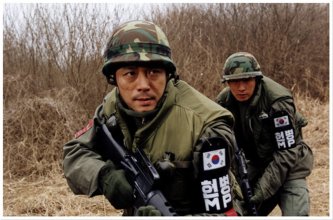 DMZ is a semi-autobiographical retelling of Director Lee Kyu-hyung's own experiences. Lee made a series of reasonably popular teen pictures in the 1980s. As it opens, Jee-hoon (Kim Jung-hoon, a pop singer and member of the group UN), an aspiring filmmaker and a stand-in for Lee, is stationed at one of the guard posts near the demilitarized zone, circa 1979. Jee-hoon befriends the tough and handsome Sergeant Pak (Lee Min-ki, whose charismatic performance is one of the film's very few saving graces) and the diminutive and elfin Sergeant Kwon (Jeong Eun-pyo, the veteran character actor from Natural City and Break Out), creating their own little oasis in the border patrol outpost, dubbed "Hotel Coconut (interestingly "colonialist" in its evocation of a mock-Southeast Asian flavor)." This early part of the film, while recycling tiresome burlesque situations from old Korean comedies, such as the rookie soldiers made to march wearing nothing but women's underwear, at least generates some sense of been-there-for-real authenticity. Sequences such as Jee-hoon setting up a "special screening" for his mates of the "make out" footage censored from the Korean films of that era are even interesting from a historian's perspective.
Unfortunately, DMZ goes completely berserk when it hits the 45 minute point or so, as the simmering hostility between North and South finally explodes and the film abruptly turns from a mildly pleasant but hackneyed teen comedy into a mind-warpingly crude "action" movie that happily regurgitates all the offensive macho characteristics of the most blockheaded Hollywood war films. When Jee-hoon makes the "first kill," rock-n-roll guitar blares triumphantly in the soundtrack, announcing that, yes, he is now a "man." North Korean characters are straight out of the 70s anti-Communist TV dramas: calling them "cartoonish" would be an insult to the cartoons. The depiction of the North Korean "headquarters" has the kind of this-set-is-made-from-leftover-TV-store-cardboard-boxes quality that reminded me of cheesy '50s science fiction films, you know, the ones with aliens with cut-up ping pong balls for the eyes. I briefly contemplated the possibility that this was some kind of an elaborate joke on the anti-Communist mentality of the Koreans at the time, so surrealistically bad was the whole thing. In a later, unintentionally funny sequence in which Jee-hoon has to "execute" a "good" North Korean soldier, copious amount of tears streaming down his face, I actually felt sorry for Kim Jung-hoon, a huge close-up of whose scrunched face fills the screen for interminable minutes: he looks like a twelve-year-old boy who received a thrashing from his schoolmarm for putting a live frog on her chair.
To cap it all off, Director Lee adds the monumentally crass final sequence in which Jee-hoon has grown up to become a film director (with the kind of ridiculous white-hair/old age makeup that a high school theater production would not be caught dead with) and attempts to make a "reconciling" gesture toward the North Koreans in the spirit of the "Sunshine Policy." Not only is this sequence amazing in its blithe condescension to North Koreans, it is also flat-out incredible in its bald inability to push even the most basic tear-jerking emotional buttons. Imagine Ed Wood Jr. "directing" a sequence of a Korean woman tearfully reading a letter, while zonked out on a bottle of Valium, and Criswell providing a tremolo narration with the odd Doppler effect, ("I I I used to know your fa fa fa ther ther ther...") and maybe you have some approximation of the sequence as presented here.
In the end, when the disconcertingly anachronistic macho posturing, mothball-smelling "teen film" genre conventions of yesteryears and the magic-marker-stenciled, frankly hypocritical "messages" are subtracted from this misfire, all that remains is lame, unfunny comedy and trite, sub-MTV "action" sequences. Whatever goodwill one feels toward the sincerity of the project thoroughly evaporates by the time Jee-hoon is shown pumping M-16 leads into a Commie bastard's abdomen, posing like a high school bass player channeling the living spirit of Billy Idol ("You must pop them in the guts!"). Had Lee simply focused on his autobiographical experiences, including "boring" details about his experiences in the DMZ outpost, and ignored the impulse to cater to the 21st-century youth market, the film would at least have retained a measure of dignity. As it stands, however, DMZ is nothing more than a misbegotten result of a deadly encounter between the thoroughly outdated "old" practices of Korean filmmaking and the blatantly "commercial" calculations of today's Korean film industry. (Kyu Hyun Kim)

Flying Boys has a plot, of course -- and an interesting one -- but more important than the events it covers, the film's heart lies in sketching an honest, understanding portrait of a particular time in life: the last year of high school. For Koreans, this year is a crucial one, as it entails taking a test (given only once a year) that will determine whether or not they can go to university. If they fail, or don't score high enough to attend the school of their choice, then they have to spend another 12 months studying for a second crack at the test a year later. Apart from the pressure this creates, there are the more universal challenges that high school seniors cope with: the awkwardness of adolescence, fighting with family members, falling in love. Flying Boys is about capturing all the confusion, emotions and energy of this time of life.
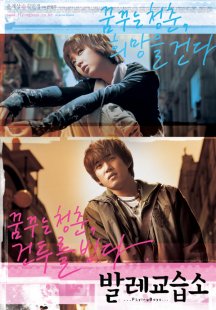 Min-jae (played by Yun Gye-sang, a pop star making his film debut) is a kid who looks like he does well in school, who doesn't. He lives with his father, an airline pilot, after having his mother pass away a year earlier. He has long had a fascination with a girl named Su-jin who lives in his apartment building, but he's too scared to approach her. "If she rejects me, I'll have to move out," he says to his friends. Meanwhile, the smart and competent Su-jin (played by Kim Min-jeong of L'Abri) is frustrated with her life and family, and itching to rebel, or at least get away. She tells her parents that she'll study at a low-ranking university in Jeju Island -- which in most people's eyes would be throwing away her talent.
Min-jae and Su-jin are thrown together in an unexpected setting: at a ballet studio. Both are forced to take ballet lessons against their will, but as time passes they get acquainted, and they also get to know the odd cast of characters who make up their class. (The original title of this film translates as "Ballet Studio"... yes, this is another Korean film that has been shackled with an awkward, stupid title, when a straight translation would have done fine)
The film starts off with an admirable economy in its storytelling, as we are oriented quite quickly into these kids' lives and their stories. Our two young leads may come across as inexperienced in their acting at times, but they are extremely charismatic and enjoyable to watch. A kiss scene between the two is one of the best moments in Korean cinema this year, just awkward and realistic enough to be heartbreaking. Unfortunately, however, the pace of the film slackens in its second half. At close to two hours in length, Flying Boys is in no rush to reach its conclusion, and while on a personal level I didn't mind so much, objectively it saps the film of some of its strength.
Still, it's hard not to look on this film with a great deal of affection. It's very good at portraying the small victories and losses we face in the process of becoming an adult. And my respect for director Byun Young-joo continues to rise. After completing her acclaimed trilogy of documentaries about Comfort Women, everyone was expecting her to move into austere, highly political feature filmmaking. Her fiction debut Ardor (2002) was not what critics were expecting, however, and with Flying Boys she commits herself further to making genre films that are audience-oriented, while refusing to compromise her personal ideals. When directors make controversial films we often call them daring, but usually this isn't really the case -- they risk offending only their enemies, and their friends are certain to rally to their side. Byun Young-joo's career choice was perhaps more genuinely daring, as she gave up an easy path to critical acclaim, and took on something that was closer to her heart. (Darcy Paquet)

Many, who have made digital films, said that the key word for digital filmmaking is liberation: liberation from heavy equipments, liberation from the long hours of setting the lights, liberation from the old system and method, and, above all, liberation from the conventional film language. Of course, this liberation was possible or became possible due to the liberation of capital. It is an irony that less capital gives more freedom.
Park Ki-yong, director of Motel Cactus and Camel(s)
Perhaps director Noh Dong-seok felt liberated in making his DV-ed debut film My Generation, a black/white number with brief eruptions of color, but his characters are anything but free. Their lesser capital constrains them. As a result, they seem to simply float through their world despondent and anxious about how they will cover their debts rather than realizing any sense of agency.
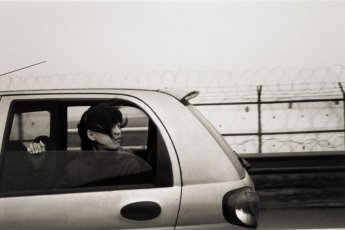 Kim Byoung-seok and You Jae-kyoung (both played eponymously) are a couple. Noh chooses to present their intimacy as a casual one, occasionally playful, occasionally pathetic. The playfulness arises in little scenes such as Byoung-seok jokingly bumping Jae-kyoung along the hallway on route to a room of a love motel where some very different kinds of bumping will be going on. Or my favorite scene where Jae-kyoung waits in Byoung-seok's car. When he knocks on her window, he crouches and does a strange 360-degree turn, as if he's a mechanical toy or an amusement park ride. His mechanical-ness is enhanced by the sound of Jae-kyoung's drawing down of the car window. Jae-kyoung greets Byoung-seok by lunging towards him with a little-dog-like bark-bite, reminiscent of the reverse anthropomorphism we witnessed in Noh's short "Doggy." It's a simply strange, but wonderfully endearing, scene. Although the film doesn't survive as a completely satisfying whole, it's through little pieces like this that I am permitted pleasant memories of my My Generation viewing experience.
The pathetic aspects of their relationship revolve around their mishandling of their limited finances and futures. Byoung-seok fuels fires for barbeques at Korean restaurants, while Jae-kyoung has trouble holding a job for more than a day. Byoung-seok has paid off the debt he acquired when purchasing a video camera; however, his older brother's contract with a loan shark brings the debt back. And when Jae-kyoung buys into a pyramid scheme, the debt gets to an even greater frightening level.
Byoung-seok seeks to name this as "our debt", his and Jae-kyoung's. The word uri, which both characters use throughout this exchange, can mean "we", "us", or "our" and can contain strong connotations of community and shared destiny. Yet it can also mean the more singular "my." It is this very linguistic milieu that brings Korean-American writer Ha-yun Jung, in her contribution to The Genius of Language: Fifteen writers reflect on their mother tongues, to wonder, "Perhaps this is why I write in English, and not in the language I was born into." Like Jung, Jae-kyoung seeks her own space. Jae-kyoung wants a "me" separate yet part of the "we." She wants her own financial agency to add to her relationship's greater whole. She may indeed need Byoung-seok's help right now in getting out of this mess, but she wants him to know how much she hates that. Ironically, Jae-kyoung's need for financial space within their embrace is exactly what Byoung-seok needs as well. For Jae-kyoung's additions to their debt trigger Byoung-seok's anxiety and resentment regarding his brother's financial dependence that has left Byoung-seok drowning in debt. The very pattern Byoung-seok fears re-establishing is what Jae-kyoung demands not continue, claiming her debt outside of "our debt."
Although 2004 was not a year of great films from South Korea, one of the factors that keeps me intrigued is the multiple cinematic references to the "affordances" (the uses a thing allows) of different technologies. The most obvious technology, of course, is the cell phone. And through the more-than-props of cell phones, Korean cinema continues to ask questions of its characters and plots similar to what Frank Rose states, in a Wired magazine article from May 2005, Samsung asks about its customers - "How do they use the product? How do they manipulate it? What does their facial expression say?" In My Generation, cell phones signify something deeper than the bling-bling that beeps and bleeps on the outside. Cell phones allow for connection over distances as distances are traveled throughout the day. A cell phone contract allows maintenance of contact, something Jae-kyoung and Byoung-seok desperately need. Yet, they aren't constantly chatting away on their cell phones either. Notice the times when they abruptly hang-up on people or refuse to answer. These are the moments when their financial problems impose upon their lives rather than supporting and enhancing them. Cell phones exist both as a means for these characters to connect during moments when they might feel most isolated and disconnect when they feel most infringed upon. Similarly, Byoung-seok is also attempting to use his video camera as a medium to convey his own sadness and to understand the sadness of others, such as his often sullen girlfriend. Yet Jae-kyoung lets him know that this tool can also present an obstacle to intimacy. Park Ki-young is correct that technology can be used to liberate us, but as My Generation reminds us, just as many moments arise when we need to liberate ourselves from this same technology in order to simply be us. (Adam Hartzell)